Deputy Minister Dr Nomalungelo Gina calls for coordinated innovation push at inaugural SA Innovation Week 2026
In her opening address at SA Innovation Week 2026 in Johannesburg today, Deputy Minister Dr Nomalungelo Gina emphasized the critical role of innovation in driving South Africa's socio-economic development, highlighting the DSTI's Decadal Plan targets and urging stronger collaboration to bridge R&D funding gaps, commercialize prototypes, and build future-ready skills.
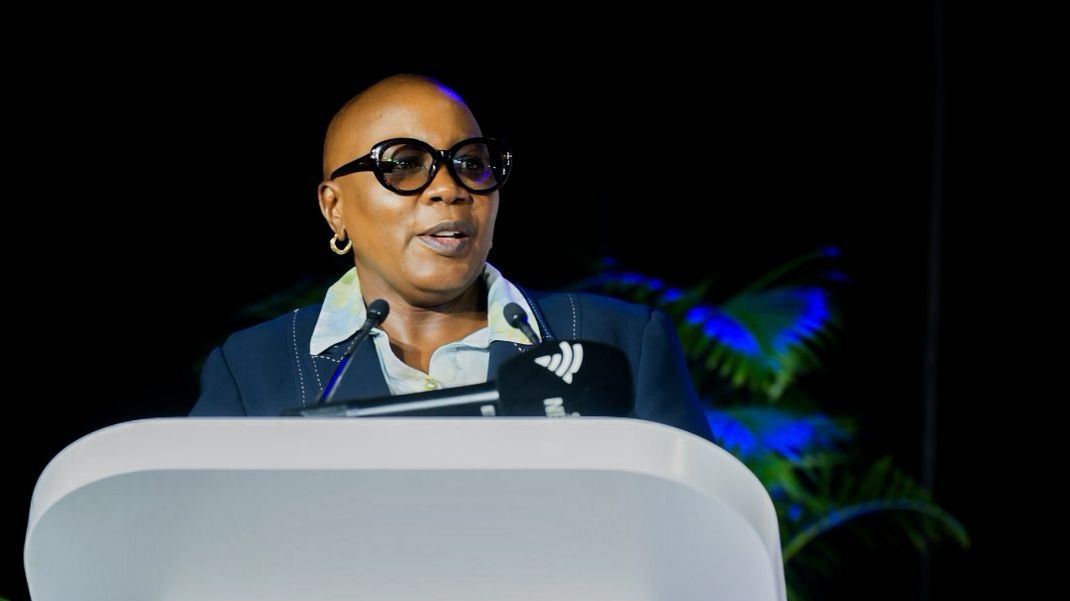
Deputy Minister of Science, Technology and Innovation, Dr Nomalungelo Gina, delivers the opening address at SA Innovation Week 2026 at the NASREC Expo Centre in Johannesburg on 18 March 2026. (IMAGE: DSTI)
Historic opening sets the tone for National Innovation Festival
Today, March 18, 2026, at the NASREC Expo Centre in Johannesburg, the inaugural SA Innovation Week 2026 (SAIW’26) officially commenced with a compelling opening address by Deputy Minister of Science, Technology and Innovation, Dr Nomalungelo Gina.
Welcoming a diverse gathering that included Chairperson of the TIA Board Mr Loyiso Tyira, Acting CEO Ismael Abdoola, leaders from Southern African Innovation Week, UCT Vice Chancellor Prof Mosa Moshabela, academics from various universities, government and industry representatives, innovators from across the country, and enthusiastic delegates, Gina delivered a message centered on unity, urgency, and actionable change.
"Receive our warm welcome as the Department of Science, Technology and Innovation in this South African Innovation Week. This flagship initiative by the Technology Innovation Agency is important to the Department, whose mandate is to drive innovation as part of its DNA and to strengthen the National System of Innovation. In this regard, I congratulate TIA on organising the SA Innovation Week (SAIW)," said Gina.
Gina underscored that innovation remains the lifeblood of any forward-looking country and industrialisation, noting that all fast-growing economies are driven by strong investments in research and development (R&D) and a robust system for commercialising prototypes.
She stressed a key global truth:
"All countries that innovate rather than import technology solutions are the strongest."
Addressing chronic underfunding and commercialisation gaps
A significant portion of the address focused on persistent challenges within South Africa's innovation ecosystem. Gina highlighted chronic underfunding of R&D, with current Gross Expenditure on R&D (GERD) hovering around 1% of GDP, far below international benchmarks for competitive economies.
"The Department’s Science, Technology, and Innovation Decadal Plan (2022-2032), a government strategic roadmap to place innovation at the heart of the country’s socio-economic development, sets an ambitious target to increase funding for research and innovation to a Gross Expenditure on R&D (GERD) to 1.5% of the GDP, an improvement from the current 1%," she explained.
"For some time now, R&D funding has been underfunded. Industries have not been investing enough in R&D to develop new technologies and machines. Our universities have also seen a decline in R&D due to revenue challenges," she said.
She pointed to a major bottleneck and said:
"Another hurdle we face is that agencies like the Council for Scientific and Industrial Research and universities host many technology demonstrators as prototypes that have not been translated into the economy. In other words, the private sector is not taking up these technologies, which are ready for diffusion into the economy. It is these innovation gaps that we seek to address through industry partnership engagements as the DSTI."
Priority areas and strategic interventions
Gina outlined the Decadal Plan's key priority areas as "grand challenges," including:
- Modernising traditional sectors by using technology to boost productivity in agriculture, mining, and manufacturing.
- Focusing on the digital economy with attention to AI, data analytics, and the 4th Industrial Revolution to improve government service delivery and business competitiveness.
- Shifting towards sustainable, low-carbon industrial paths, better waste management, and the entire circular economy path.
To support these ambitions, the Department has established the Innovation Fund, administered by TIA, to de-risk early-stage technologies and attract private venture capital.
"Another challenge the country faces is that the future economy, driven mainly by new technologies including AI, is confronted with a skills deficit," she added.
She highlighted the need to build a pipeline of STEM-related professionals to address mismatches between graduate skills and emerging gig economy demands.
Call for ecosystem-wide coordination and inclusivity
Emphasizing collaboration over silos, Gina said:
"As I said, innovation is an engine of industrialisation and development, and we make a call for a coordinated approach rather than functioning in silo from industries, universities, science councils, agencies like TIA, and grassroots innovators. Part of this coordination is pooling funding instruments to support research, development, and commercialisation, including the registration of Intellectual Property (IP)."
"Our adopted mantra is ‘Placing Science, Technology and Innovation at the Centre of Government, Education, Industry and Science,’" she affirmed.
She praised the event's inclusivity:
"I am excited that this Innovation Week includes universities and businesses. But more importantly, young innovators are present to pitch and receive encouragement for what they are working on. This country is not short of innovators, but it is short of adequate funding mechanisms and a culture that supports project funding."
Gina highlighted initiatives like the Fund of Funds (FoF) targeting previously disadvantaged groups, grassroots innovation in townships and rural areas, and annual Innovation Awards recognizing underserved innovators, including people with disabilities. Efforts to bridge the digital divide through engagements with telcos were also noted.
Direct appeal to funders and closing vision
In a candid call to action, Gina addressed government funders:
"To the funders, especially government-owned funding instruments like the Innovation Fund, the Industrial Development Corporation, the Public Investment Corporation, the National Empowerment Fund, and others, please stop this practice of rejecting people’s applications without informing them where their applications or business plans fell short...
Please guide applications with comments on where their applications fell short so they can improve and resubmit. As government funders, we have failed so many people; we have shut down so many dreams and prevented potential innovations because we have no care or patience to provide guidance... Let’s do better for our people."
Encouraging delegates, she urged young innovators to network, understand funder expectations, and refine pitches.
In conclusion, she expressed optimism and said:
"I wish this Innovation week success, and I look forward to seeing TIA grow this initiative each year into a premier event that exceeds even the Mining Indaba and other events that capture the national attention of our country."
With over 1,500 delegates, 150+ innovations showcased, pitching sessions, the TVET Learning Lab, and the NRF's Presidential PhD panel, SAIW’26 embodies the coordinated, inclusive approach, Gina championed—positioning South Africa to harness innovation for sustainable growth, job creation, and global competitiveness.