Forensic red flags: Multi-Million Metro FM deal signed without tender, SABC confirms.
SABC hides multimillion-rand Metro FM deal and music data, raising transparency red flags over Maskandi and public funds.
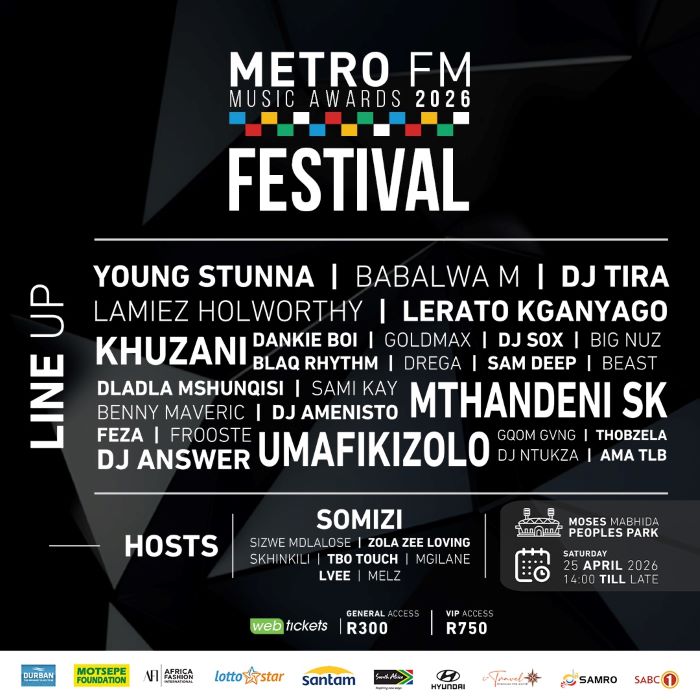
Maskandi heavyweights Khuzani Mpungose and Mthandeni SK Manqele feature prominently on the MMA 2026 festival lineup. While the SABC relies on these artists to drive ticket sales and USSD voting revenue at R1.50 per minute, the broadcaster refuses to disclose how much airplay these genres actually receive on Metro FM's daily playlists.
Behind the glitter of the 2026 Metro FM Music Awards (MMAs) lies a narrative of institutional arrogance, fiscal delinquency, and what can only be described as the commercial harvesting of cultural heritage.
As the South African Broadcasting Corporation (SABC) and the eThekwini Municipality prepare to toast to artistic excellence, The Public Dispatch can reveal a series of chilling admissions from the public broadcaster. These admissions suggest that the MMAs have become a black box where public money enters, and accountability disappears.
The "No-Tender" admission
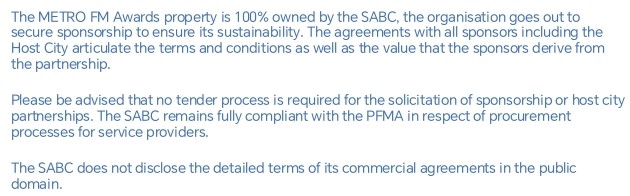
In a staggering admission that should send the Auditor-General into a tailspin, the SABC has confirmed that the three-year, R60 million hosting deal with the eThekwini Municipality was never subjected to a competitive bidding process.
When pressed on how a cash-strapped municipality, currently failing to provide basic water and sanitation to its residents, could hand over R20 million a year to a broadcaster, the SABC’s response was:
"... no tender process is required for the solicitation of sponsorship or host city partnerships. The SABC remains fully compliant with the PFMA in respect of procurement processes for service providers."
The Spokesperson for SABC, Mmoni Ngubane also shielded the specifics of this massive public expenditure deal and said:
"The SABC does not disclose the detailed terms of its commercial agreements in the public domain."In simple terms, here we have:
- A publicly owned awards property,
- Funded in part by a municipality,
- With no disclosed procurement process,
- And no public financial breakdown,
An anonymous events executive described it as:
“A perfect accountability blind spot. Public money goes in but the public can’t see the terms.”
This private club approach to public funds flies in the face of the Municipal Finance Management Act (MFMA), which mandates that all municipal spending must be transparent, competitive, and cost-effective. How does a sponsorship bypass the constitutional requirement for fair procurement?
The revenue stream they refuse to discuss
The awards are not just cultural but they are also commercial. Revenue is generated through sponsorships, advertising and critically, public voting. Voting is conducted via USSD at R1.50 per minute.
Ngubane also refused to disclose how much they generated from public votes in 2024 and MMA 2025.
“Commercial arrangements with telecommunications partners are governed by confidentiality provisions. The SABC accounts for all revenue through its statutory reporting processes, including oversight by Parliament,” Ngubane said.
This is technically compliant but strategically evasive. Parliamentary reporting does not provide event specific transparency. So the public might never know how much money is generated, who benefits and how much goes back to artists.
Harvesting the Bhinca Nation for USSD rands
The most scathing indictment of the 2026 awards is the station’s treatment of the Maskandi music community. For years, Metro FM has been accused of ignoring the genre on its airwaves, only to "invite" it to the party when there are SMS votes to be sold.
The SABC’s previous public statement leaned heavily into the language of inclusivity. In that statement Ngubane said:
"Maskandi music is currently part of METRO FM’s playlist, it aligns with the station’s sound and listener profile. There is clear audience appreciation for the genre."
She went further:
"The station has expanded its playlist to include more Maskandi and Lekompo.”
But when The Public Dispatch requested hard data including logs, timestamps, and rotation frequency, the answer shifted dramatically:
“METRO FM does not disclose granular playlist and rotation data at the level requested, as this forms part of internal programming operations. The station’s programming strategy reflects its positioning as an urban commercial radio station, while also responding to evolving audience preferences and the growth of genres such as Maskandi and Lekompo within broader music culture.”
Beyond playlist inclusion, The Public Dispatch also asked if there is a dedicated programme for Maskandi music or if they are considering having a dedicated traditional music show to ensure these artists are not just exploited for commercial gain.
"METRO FM continues to expand its support for a range of genres through both on-air programming and experiential platforms such as the METRO FM Heatwave events. Programming decisions remain within the editorial discretion of the broadcaster," Ngubane responded.
"The METRO FM Music Awards are governed by structured processes to ensure fairness, compliance, and integrity. This includes independent oversight mechanisms and internal audit processes to ensure adherence to established rules and governance standards. Programming and nomination considerations remain distinct, and editorial independence is maintained throughout," she continued.
So, there you have it,
- no direct answers.
- No figures.
- No breakdowns.
- No evidence.
This is where the narrative collapses because without data, “inclusion” becomes unverifiable and potentially performative.
The irony is that, SABC argues that their inclusion of Maskandi is not exploitation because they pay royalties.
But as every musician knows, royalties are only paid if the music is played. If airplay is minimal it means royalties will also be minimal. But if voting is high then revenue will also be high.
Ngubane reiterated that they play a central role in supporting the South African music industry through multiple platforms, including airplay, live events, and industry initiatives such as the METRO FM Music Awards conference.
As far as the development of artists she said:
"The Corporation operates within a broader ecosystem of 19 radio stations, each contributing to the development and promotion of local content across genres."
If SABC cannot prove that Maskandi music is on Metro FM, but continued to charge fans R1.50 per minute to vote via USSD, then they are not supporting Maskandi music instead they are exploiting it.
An anonymous producer said:
“Maskandi brings audience and audience brings money. But the support doesn’t match the value being extracted.”
Another prominent Maskandi artist, who preffered to speak on anonymous condition said:
"They want our fans' airtime, but they don't want our culture on their daytime shows. We are the fuel for their red carpet, but we are still treated like guests in our own house."