LPC's verification crisis: Can the public still rely on it?
Legal Practice Council issued false letter, triggered criminal case and then changed its story
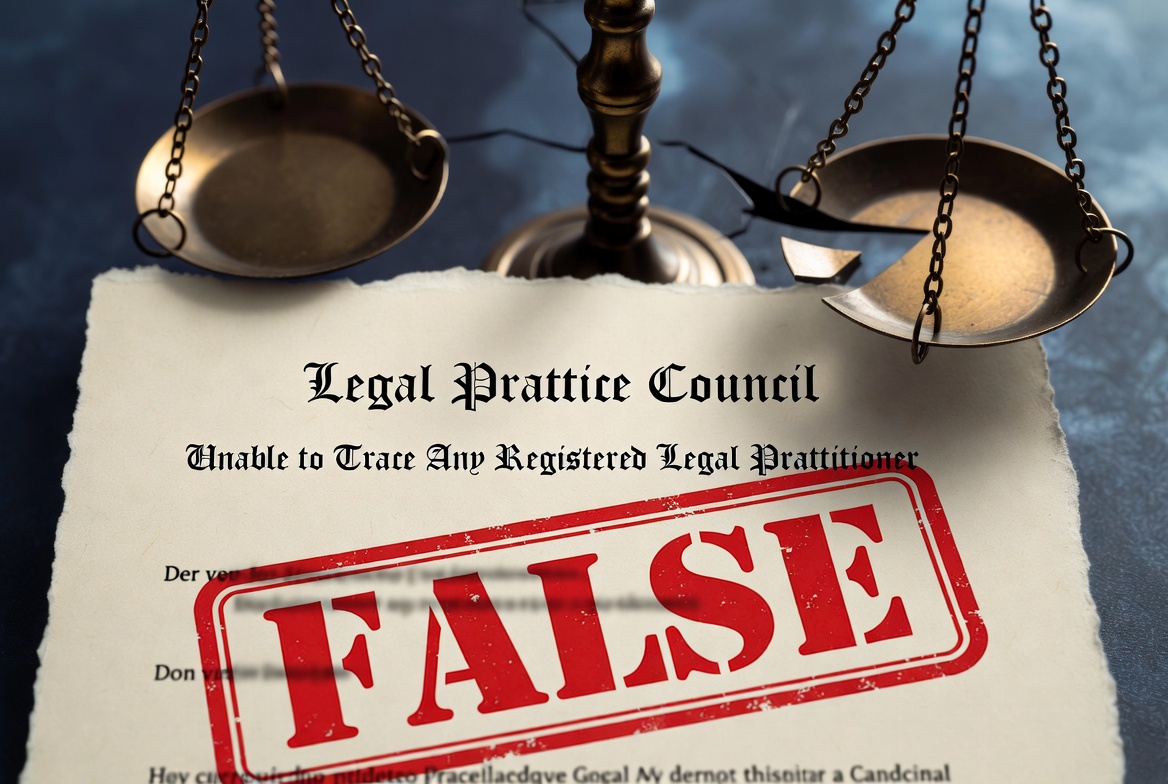
The Legal Practice Council told Sunbird Village homeowners that it was 'unable to trace any registered legal practitioner' under the name Henriet De Ru. (Image: AI generated)
The Legal Practice Council's message to the public could not be clearer.
Before paying anyone claiming to be a lawyer or advocate, verify them with the Council. Check the online register. Phone one of its offices. If money, property or trust funds are involved, make sure the practitioner holds a valid Fidelity Fund Certificate.
The Council presents this verification system as the public's first line of defence against fraud.
This series followed one case where that protection was put to the test. What follows is not spin. It is the Council’s own letters, contradictions and failures, laid out so you can see them for what they are.
The check that lied
In 2026, homeowners at Sunbird Village in Germiston did exactly what the Council begged them to do. They checked the credentials of a woman collecting levies from them who called herself an Advocate of the High Court of South Africa.
The Council wrote back with a definitive, categorical warning: it was "unable to trace any registered legal practitioner operating under the name or style of Henriet De Ru.

On the strength of that letter, a homeowner opened a criminal case for impersonating an advocate.
The Council has since admitted to The Public Dispatch that Henriet De Ru is a registered Advocate. This means their verification letter was a lie and the very system the public is told to trust had also failed.
Two stories that cannot both be true
An honest mistake can happen. What matters is how an institution explains it
When pressed on how a 'fully registered' advocate completely vanished from their system, the Council offered two contradicting answers:
First answer: They claimed some records from the Department of Justice "do not automatically appear on our system," That explanation suggested her record had not been available on the system until the Council investigated.
Second answer, When asked whether her record was only loaded because of media questions, the Council switched stories and insisted that De Ru “was registered with the LPC shortly after its establishment at the end of 2018.”
Both explanations cannot be true. If she had been registered since 2018, there was nothing to "locate." If her records had to be located after media questions, then the claim that she had always been properly registered does not explain why the Council's own system declared she did not exist.
This is not a minor inconsistency. It strikes at the credibility of every explanation the Council has offered. The Public Dispatch asked the Council to reconcile these conflicting versions. It has refused.
The excuse does not survive the evidence
The Council also suggested the problem stemmed from the migration of historical records. But its own evidence undermines that explanation. The Council confirmed that its online register routinely displays practitioners who are no longer practising. In other words, the database is clearly capable of displaying historical records that are not linked to active practice. That raises an obvious question: why would a properly admitted practitioner return a "not found" result if the system already retains records of non-practising practitioners?.
The problem was not with an entire category of practitioners. It was De Ru's record. The Council has failed to explain why.
The “correction” that corrected nothing
The Public Dispatch asked whether the Council told the homeowners who received the false letter that the letter was wrong?
The Council’s answer:
“Yes. The complainant has been informed that the complaint is being investigated.”
That is not a correction but a progress report on a misconduct probe. The letter’s central claim, that no such practitioner existed remains unretracted.
As of the Council’s latest correspondence, the homeowners have still not been told, in plain terms, that the letter was false. Pressed again, the Council said it “would need to verify with the Provincial Office".
Questions the Council will not answer
The De Ru case exposes a much bigger question.
When asked how many other lawyers are missing from this disaster of a database, the Council hid behind corporate spin. They boast about an 85,000 lawyers. The Council described the migration of records from the former law societies, recognised bar associations and the Department of Justice as having been "successfully completed."
The Council claimed that the missing records does not affect Attorneys but only affect a "very small number" of advocates outside the bars.
When asked if this database has ever actually been audited, they refused to respond. They also refused to tell us the audit date, a methodology, or the results of the audit.
Asked whether it even knows how many practitioners are still missing, not just the ones that happen to surface, the Council failed to respond. They MIGHT not even know how many ghosts are hiding in their system.
The contradiction at the heart of the Council's story
The Council's explanations create another problem. If advocate records from the Department of Justice were successfully migrated, then advocates without bar association membership should already appear on the system. De Ru should never have been missing.
If they were not successfully migrated, then the Council's repeated claim that the migration was "successfully completed" is deeply misleading. It cannot be both.
Either the migration worked as claimed, or it did not. The Council has refused to explain which version is true.
Gaslighting the public
When pressed, the Council accused this publication of chasing a “predetermined narrative” and of “trying to find a story where there isn’t one.” It claimed it answers only “based on facts.”
But the facts did not come from this publication. They came from the Council itself. Look at the record and judge that blatant gaslighting for yourself:
- A completely false verification letter.
- A criminal case launched because of their false verification.
- Two contradictory statements to cover their tracks.
- A fake "correction" that answers an entirely different question.
- Total refusal to admit how broken their database actually is.
These are not the media's facts, these are the LPC's own admissions.
Why every South African should care
This case is about far more than one advocate in Germiston. It is about whether the public can trust the country's legal regulator.
The Legal Practice Council instructs South Africans to rely on its verification system before handing over money, buying property or trusting someone with their legal affairs. Yet this investigation has shown that the system wrongly declared a 'genuine advocate' not to exist.
A regulator does not earn public trust by demanding it. It earns trust through accuracy, transparency and accountability. In this case, the LPC has demonstrated none of those convincingly.
The Council tells South Africans to rely on its verification system before entrusting anyone with legal work or paying them money. But if the system cannot be trusted when it says a practitioner cannot be found, its credibility as a public safeguard is fundamentally undermined.
This is not just one homeowner's problem. It is a problem for every South African who has been told to trust the LPC's verification system