NAC Council is gone: How does it affect PESP7 & who must return the iPhone 17s
What does this mean for council members and are artists and adjudicators affected? The Public Dispatch answers each question plainly.
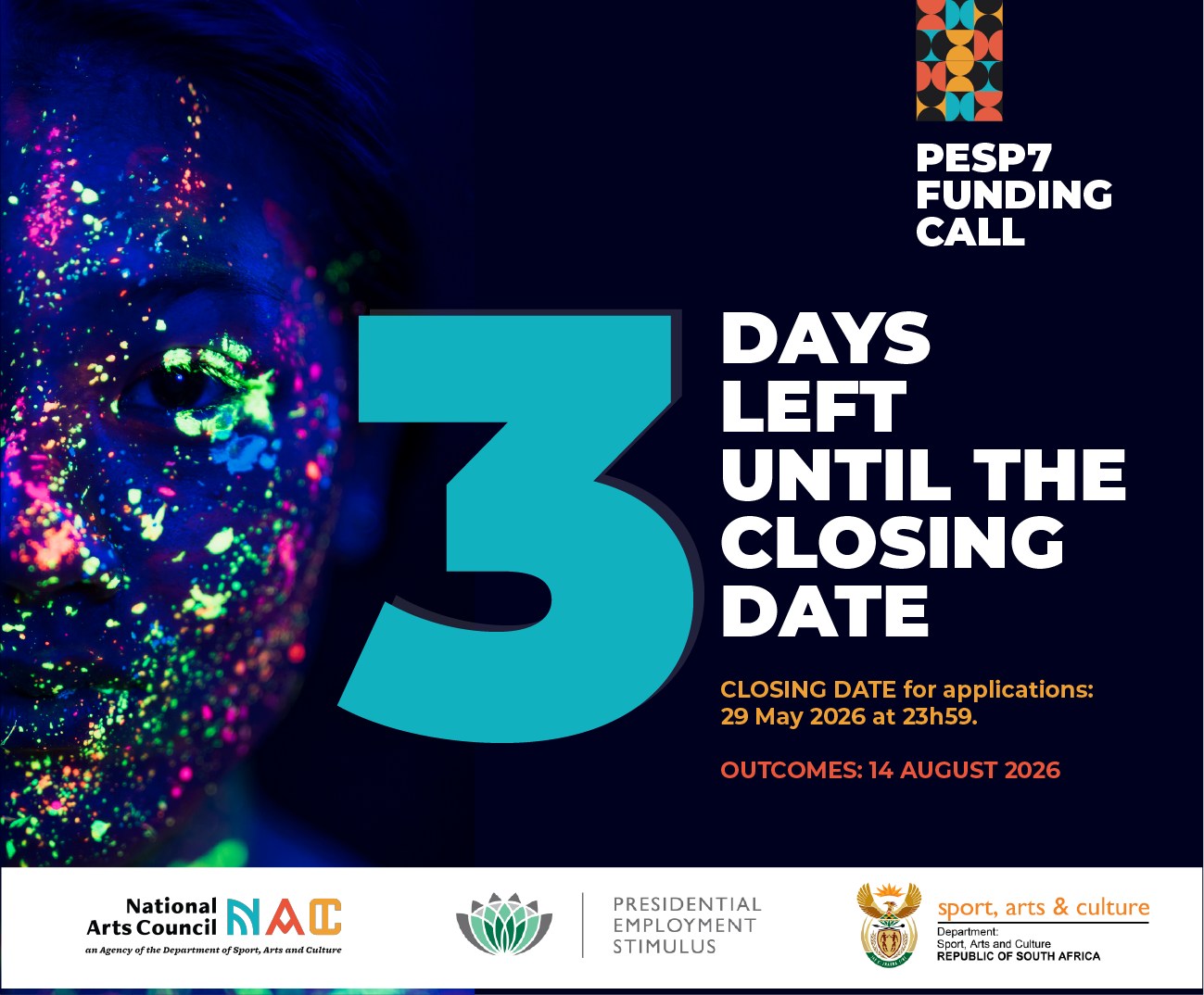
Who now has the legal authority to approve funding for the thousands of artists who apply before Friday's deadline. (Image:NAC)
What does dissolution actually mean?
When Minister Gayton McKenzie signed the dissolution letter on 25 May 2026, invoking Section 5(5) of the National Arts Council Act 56 of 1997, he did not suspend the council, he dissolved it.
That word has a precise legal meaning. It means the council ceased to exist as a governance structure the moment that letter was signed.
Every single member, the Chairperson, the Deputy Chairperson, all provincial representatives, every council member ceased to hold office with immediate effect.
Former Chairperson Eugene Botha confirmed this to The Public Dispatch in writing on 26 May 2026.
"I confirm that I have received the Minister's letter dated 25 May 2026, and that I ceased to hold office as Chairperson of the National Arts Council as of that date. I respect the Minister's decision and I do not intend to contest it."
There will be no legal challenge. The dissolution stands.
Does the Board dissolution affect PESP7?
This is the question most artists and the public have been asking
The answer is yes, potentially, but there are mechanisms to prevent disruption and delays if DSAC acts quickly.
Stage 1: Applications — NOT Affected
The application process is purely administrative. Artists submit applications through the online portal. Acting management receives and processes those submissions. No council approval is needed for this stage. The closing date remains 29 May 2026
Artists must still apply. The deadline has not changed. The portal is live. Nothing about the dissolution affects this stage.
Stage 2: Adjudication: POTENTIALLY affected but manageable
Adjudicators are independent experts appointed to score and evaluate applications. They are not council members. The dissolution does not remove them.
However, adjudicators are typically appointed by or with the council's approval. If any new adjudicator appointments need to be made for PESP 7, those need to be authorised by whoever is designated as the interim accounting authority. Since the adjudicators were already appointed before the dissolution there should be no disruptions.
The risk is there but very minimal if DSAC moves quickly to designate the interim accounting authority.
Stage 3: Approval of funding decisions
This is where the dissolution creates a real and serious problem. Under the NAC Act and the PFMA, funding decisions, determining which applications succeed and which do not must be approved by the accounting authority.
That is a governance function not an administrative one. Acting management cannot approve funding. The CEO cannot approve funding. Only the accounting authority can.
Until DSAC designates an interim accounting authority, no PESP 7 grant can be lawfully approved. No rand can be committed. No award letters can be issued.
Results are expected on 14 August 2026. That is approximately 11 weeks away. If DSAC appoints an interim accounting authority within days, which the dissolution letter explicitly directs there is sufficient time for adjudication to proceed and results to be announced on schedule.
But if DSAC delays, (as they always do) the 14 August date becomes impossible and artists will have to wait longer.
Stage 4: Payment of grants — DEPENDENT on Stage 3
Grants cannot be paid until they are approved. Approval cannot happen without an accounting authority. The payment timeline flows directly from how quickly DSAC acts.
McKenzie said that the appointment of a new council will proceed without delay and in strict accordance with the law, and that his priority is to ensure the NAC has stable, capable governance in place as soon as possible so that its work in support of artists continues without interruption.
The PESP funding itself — NOT at risk
PESP funding comes from the Presidency as a stimulus programme. It is ring-fenced. The dissolution of the NAC council does not cancel the funding allocation or return it to Treasury. The money exists. The question is only about the governance process needed to approve its distribution.
Are former council members still members?
No, from 25 May 2026, former council members hold no office at the NAC. They have no authority to call meetings, pass resolutions, make procurement decisions, sign contracts, or act in any capacity on behalf of the institution. Any attempt to do so would have no legal force. They are, as of today, private citizens.
What about the iPhones?
The Public Dispatch reported that approximately 18 Apple iPhone 17 devices were procured for provincial council members at a potential cost of between R374,382 and R944,982 of public money.
The council has been dissolved and those people are no longer members, meaning cellphones remain state assets.
Under Treasury Regulation 10, state assets must be properly registered, safeguarded, and returned when the purpose for which they were issued no longer exists. The purpose no longer exists. The phones must come back.
Under Section 45 of the PFMA, officials of public entities are required to take effective steps to safeguard assets. DSAC, which now has oversight of the NAC pending the appointment of a new council, has an obligation to ensure those devices are recovered.
NAC management which remains in place under the acting CEO and CFO has the same obligation.
Here is what must happen in practice. NAC management should issue a formal written notice to all former council members requiring the return of any NAC, owned devices within a specified period. Every device must be reconciled against the asset register. If any former council member refuses to return a device, the NAC has legal remedies including civil recovery action.
If the devices were never placed on the asset register, which would itself be a violation of Treasury Regulation 10, the situation becomes more serious. It means the procurement may never have been properly processed. That makes it both a financial management failure and a potential forensic matter for the Auditor-General.
The Public Dispatch is watching this closely. The five-working-day financial report ordered by the Minister, due by 1 June 2026 must account for all significant expenditures in the current financial year. Device procurement falls squarely within that obligation.
Who is running the NAC right now?
The dissolution letter is clear on this point. The Director-General of the Department of Sport, Arts and Culture, or her delegate, will determine the designation and functions of the accounting authority pending the appointment of a new council.
Acting CEO and acting CFO continue to manage day-to-day operations but they now report directly to the Department, not to a board.
Any appointment process for the CEO and CFO positions is or should be frozen by now. There is no council to oversee it. Whatever was happening with the external recruitment firm the NAC hired at potential cost of up to R1 million of public money is in limbo. That contract, and the fees already paid or committed under it, will need to be accounted for in the five-working-day report.
Are Adjudicators affected?
Not directly. Adjudicators are independent experts appointed per funding window to score and evaluate grant applications submitted by artists and organisations. They are not council members. The dissolution of the council does not remove adjudicators from their current engagements. If a funding window is open and adjudicators are currently scoring applications, that work continues under the oversight of acting management.
What about the bonus dispute?
This is the most urgent unresolved question because it directly affects people's ability to pay their bills.
The bonus dispute covering financial years 2019/20, 2020/21, and 2021/22 has not been settled. The council that was supposed to approve the settlement is gone.
The dissolution does not automatically settle the dispute. But it removes the obstacle that was blocking settlement, a council that dithered for 37 days after a ministerial instruction to act urgently.
The Minister's dissolution letter directs management to prepare and submit a comprehensive financial and operational report to DSAC within five working days. That report must include a full account of all legal costs incurred in relation to the bonus dispute.
Critically, someone must now be authorised to sign a settlement agreement with NEHAWU. The Minister's 22 April letter set out the terms, once-off full and final settlement, not a backdated bonus, not an admission of entitlement, funded within the approved budget.
The settlement agreement requires a duly authorised representative of the NAC to sign it. With no council, that authority rests with whoever the Director-General of DSAC designates as the accounting authority in the interim. That designation must happen quickly.
What happens to the New Council?
Two options are on the table.
- A new council, appointed through the process set out in the NAC Act, which involves public nominations and ministerial appointment.
- Or an interim administrator, a single person or small team appointed to govern the institution while the longer process of constituting a full council takes place.
The interim administrator option is faster. It is likely the route the Minister takes first, given the urgency of the situation.
What matters most about whoever comes next is independence. The new council or administrator must have no connection to the previous council, no relationship with Diphofa or Bhoola, and no interest in the outcomes of the permanent CEO and CFO recruitment process. The entire point of the dissolution is to reset the institution's governance. A new council that simply reinstates the same dynamics would be a dissolution in name only.
The report due on 1 June 2026
Mark this date.
The Minister ordered management to submit a comprehensive financial and operational status report to DSAC within five working days of 25 May 2026. Five working days is 1 June 2026.
That report must include a full account of all legal costs incurred in the bonus dispute and all other significant expenditures in the current financial year.
It should and must address the device procurement, the external recruitment firm contract, and the SCM processes used for both.
What The Public Dispatch is watching
This story did not end with the dissolution. It entered a new phase. Here is what this publication will be reporting on in the days and weeks ahead.
- Whether the five-working-day financial report is submitted on time and whether it is made public.
- Whether former council members return the iPhone 17 devices and whether NAC management formally demands their return.
- Whether the bonus dispute is settled urgently and employees receive their money.
- Whether the acting CEO and acting CFO continue in their acting roles or whether DSAC makes changes to acting management.
- Whether the incoming administrator or new council is genuinely independent.
- And whether the external recruitment firm is paid out, its contract cancelled, or its mandate extended and who authorises any of those decisions.
Each of these is a public interest matter. Each of them involves public money. Each of them will be reported on.