Nzimande to lead historic Indigenous Knowledge Systems
DSTI Minister, Blade Nzimande will convene a landmark meeting in Durban this Friday to formalize the integration of Indigenous Knowledge Systems (IKS).
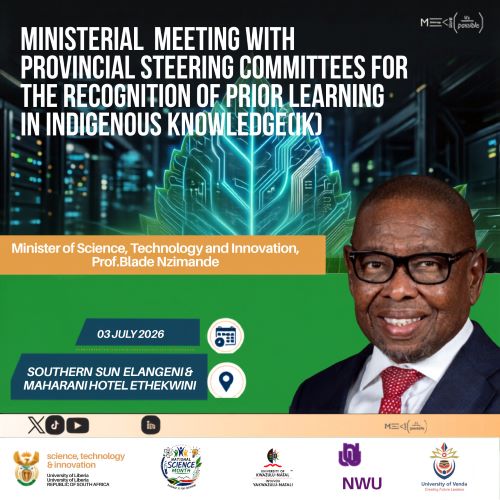
Science, Technology and Innovation Minister Prof. Blade Nzimande will convene a historic meeting with Provincial Steering Committees for the Recognition of Prior Learning in Indigenous Knowledge Systems (IKS) in Durban on 3 July 2026.(Image: supplied)
Science, Technology and Innovation Minister Blade Nzimande will convene what the Department of Science, Technology and Innovation (DSTI) has described as a historic meeting with Provincial Steering Committees responsible for the Recognition of Prior Learning (RPL) in Indigenous Knowledge Systems.
The meeting will be held on Friday, 03 July at the Southern Sun Elangeni & Maharani Hotel in Durban. This forms part of government's broader efforts to elevate Indigenous Knowledge as a recognised pillar of South Africa's science, innovation and development agenda.
The meeting follows commitments made by Nzimande during his 2024/25 Budget Vote speech, where he identified Indigenous Knowledge as one of the department's strategic priorities and pledged to expand both the scale and impact of government programmes supporting Indigenous Knowledge Systems (IKS).
Momentum behind the initiative grew in March 2025 when the minister convened the inaugural Summit on the Transformation of South Africa's National System of Innovation. Among the summit's key resolutions was a call for the institutionalisation of Indigenous Knowledge within the country's public science system, while strengthening its contribution to socio-economic development.
Friday's engagement will provide Nzimande with a progress report on the work undertaken to recognise Indigenous Knowledge practitioners through Recognition of Prior Learning mechanisms.
The discussions will include the development of assessment tools designed to formally acknowledge the expertise of Indigenous Knowledge holders, many of whom have acquired their knowledge outside conventional academic institutions.
The meeting is also expected to examine progress made in expanding opportunities for Indigenous practitioners, identify challenges that continue to hinder recognition, and gather feedback from practitioners on whether the proposed assessment tools and recognition mechanisms are appropriate and culturally relevant.
A broad range of stakeholders will participate in the discussions, including amakhosi, chairpersons of Provincial Houses of Traditional and Khoi-San Leadership from KwaZulu-Natal and North West, representatives from royal houses, Indigenous Knowledge practitioners and traditional healers, healthcare professionals, academics, policymakers, and government departments and agencies.
According to the Department, the engagement is intended to strengthen the social compact between government and Indigenous Knowledge communities while ensuring that those who preserve and practise Indigenous Knowledge play a central role in shaping the systems designed to recognise their expertise.
The initiative also supports several key legislative and institutional frameworks introduced by the DSTI, including the Indigenous Knowledge Systems Policy, the recently gazetted Indigenous Knowledge Regulations, and the establishment of the National Indigenous Knowledge Systems Office.
For decades, many Indigenous Knowledge practitioners have argued that their knowledge has been undervalued despite its contribution to healthcare, biodiversity conservation, agriculture, environmental management and cultural preservation.
Government believes formal recognition could improve the protection of Indigenous intellectual property, create economic opportunities for practitioners and encourage stronger collaboration between Indigenous Knowledge holders and the scientific community.
The meeting comes a day before the official launch of the DSTI's inaugural National Science Month, which replaces the long-running National Science Week programme. The month-long initiative will be officially launched on Saturday at the Vaal University of Technology in Gauteng and will run from 4 to 31 July.
Indigenous Knowledge has been identified as one of the flagship themes of National Science Month, reflecting government's intention to promote African knowledge systems alongside mainstream scientific research and innovation.