Parliament's selective conscience: Lions get a ban, but critically endangered black Rhinos face the bullet.
While all nine provinces united to shut down the captive lion industry, Minister Willie Aucamp’s department is quietly clearing the way to put 12 critically endangered black rhinos a year in front of foreign hunters’ rifles. A formal parliamentary petition accuses the government of policy schizophrenia and demands the NCOP apply the same moral standard to the last of South Africa’s black rhinos.
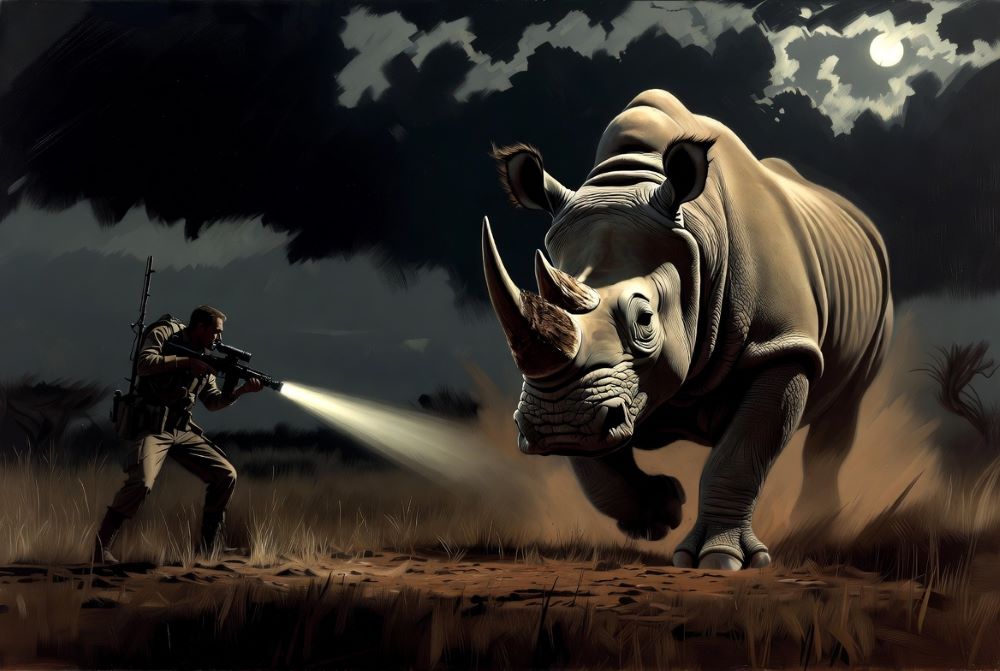
A black rhino in its natural habitat. South Africa holds approximately 2,300 to 2,600 of the world's remaining critically endangered black rhinos ,yet the Department has proposed permits for 12 to be killed annually as hunting trophies. (Illustration: AI-generated)
On 24 March 2026, all nine provinces of the National Council of Provinces voted unanimously to approve a Draft Notice Prohibiting Certain Activities Involving African Lions.
It was the clearest signal South Africa’s Parliament had ever sent on wildlife exploitation: the captive lion industry, responsible for the industrial breeding and commercial killing of an estimated 8,000 to 12,000 animals across more than 350 facilities, was effectively being shut down.
Six days later, a document landed in the NCOP Petitions Office, the Portfolio Committee on Forestry, Fisheries and the Environment, and on the desk of the NCOP Chairperson.
It asked a question that South African legislators apparently do not want to answer: if Parliament has the moral conviction to ban captive lion breeding, why does it stand by silently while the Department issues permits for wealthy foreign hunters to shoot critically endangered black rhinos?
The petition was filed by the South African Nature Conservation Investment and Development Trust (SANCID), a registered trust (Reg no: 8023/95) chaired by Ruwart de Jong, a conservation advocate who served under the National Parks Board in Kruger National Park during the late 1980s and early 1990s. It is addressed to Parliament and names Minister Willie Aucamp directly.
The petition: A direct challenge to Parliament’s consistency
The SANCID petition is not a vague appeal to conscience. It is a structured, referenced demand for policy coherence. De Jong’s submission draws a direct line between the NCOP’s unanimous 24 March decision on captive lions and the Department’s ongoing intention to issue trophy hunting permits for black rhinos under CITES export quotas proposed for 2026 and 2027.
The petition’s core argument is devastating in its simplicity:
“We now respectfully call on Parliament to apply the same level of protection and policy consistency to the Critically Endangered black rhino by intervening to stop the issuing of trophy hunting permits by Minister Willie Aucamp.”
De Jong’s submission documents his prior engagement with the previous minister, Dr Dion George, to whom he wrote on 15 September 2025 urging an immediate halt to rhinoceros trophy hunting permits. As the petition notes, George was subsequently removed from his position, a removal that the conservation community has extensively documented as linked to his willingness to confront the trophy hunting lobby.
The petition sets out four explicit requests to Parliament:
- first, to adopt a policy consistent with the 24 March decision on captive lions;
- second, to direct or urge Minister Aucamp not to issue trophy hunting permits for black rhinos;
- third, to initiate oversight on the proposed CITES export quotas for critically endangered species;
- and fourth, to support the expansion of non-lethal conservation programmes, particularly using underutilised government and communal land in KwaZulu-Natal for black rhino repopulation.
Twelve Rhinos a year: the numbers that don’t add up
The scale of the policy contradiction is staggering when examined against the facts. The black rhino (Diceros bicornis) is listed as Critically Endangered on the IUCN Red List. South Africa holds a significant portion of the remaining global population, approximately 2,300 to 2,600 individuals, with roughly 650 of those found in KwaZulu-Natal.
Against this backdrop, Minister Aucamp’s February 2026 Government Gazette proposed export quotas of 12 black rhino hunting trophies per year for both 2026 and 2027, alongside 150 elephants (300 tusks) and 11 leopards.
The gazette notice followed a four-year freeze on such quotas, a freeze that had been in place partly as a result of legal action by Humane Society International/Africa, which challenged the lawfulness of the quota-setting process itself.
The Born Free Foundation has noted that the proposed black rhino quota appears to exceed the 0.5% limit agreed under CITES Resolution Conf. 13.5.
As the petition bluntly states:
“Black rhinos have extremely slow reproduction rates and low genetic diversity.”
The species produces a single calf after a gestation period of approximately 15 months, with inter-calving intervals of two to five years. Every individual animal matters. Twelve per year is not a number that can be dismissed as statistically negligible when the entire national population would fit inside a single large stadium.
The law is clear: The Government is ignoring it
The SANCID petition invokes the precautionary principle enshrined in the National Environmental Management Act (NEMA), Act 107 of 1998.
Section 2(4)(a)(vii) of NEMA is unambiguous: where there are threats of serious or irreversible damage, a lack of full scientific certainty shall not be used as a reason for postponing cost-effective measures to prevent environmental degradation.
The black rhino is a textbook case for the application of this principle. The species was hunted to the brink of extinction in the twentieth century, declining from an estimated 850,000 animals to fewer than 2,500 by the early 1990s. Recovery has been painstaking and remains fragile. The Department’s own assessment acknowledges the species’ critically endangered status.
Yet the proposed quotas proceed as though the precautionary principle exists only in theory.
Section 24 of the Constitution of the Republic of South Africa provides that everyone has the right to have the environment protected, for the benefit of present and future generations, through reasonable legislative and other measures that secure ecologically sustainable development. NEMA further establishes that the environment is held in public trust for the people.
Trophy hunting quotas that lack transparent scientific methodology and are set by a minister with documented ties to the hunting industry do not meet this standard.
The National Environmental Management: Biodiversity Act (NEMBA), Act 10 of 2004, provides the specific regulatory framework for threatened and protected species.
Chapter 4 of NEMBA regulates threatened or protected ecosystems and species, with Chapter 7 outlining permit requirements and Chapter 9 covering biodiversity-related offences. The issuance of hunting permits for a species listed under the Threatened or Protected Species (TOPS) regulations demands rigorous scientific justification, justification that has not been made publicly available.
KwaZulu-Natal has already proven there is a better way
Perhaps the most damning element of the SANCID petition is its documentation of a proven, non-lethal alternative to trophy hunting that is already operational and successful in the very province where De Jong’s trust is based.
The WWF Black Rhino Range Expansion Project (BRREP), established in 2003 as a partnership between WWF and Ezemvelo KZN Wildlife, has translocated over 230 black rhinos to create 15 new populations across South Africa and Malawi.
More than 200 calves have been born on project sites. Black rhino range in South Africa has expanded by more than 250,000 hectares through BRREP, with a 49% increase in range within KwaZulu-Natal alone.
The project’s milestones are remarkable. In 2017, for the first time, rhinos born on a BRREP site were themselves translocated to establish a new population, a closed loop of conservation success. In 2019, BRREP completed the largest international black rhino translocation by air in history, flying animals from Durban to Malawi in a Boeing 747. In 2022, four orphaned black rhinos, victims of poaching rescued as calves were relocated to Babanango Game Reserve in northern KZN, establishing a new population using orphaned animals for the first time.
Babanango itself is a model of community-based conservation. The 20,056-hectare reserve operates on land leased from local communities under long-term agreements that include job creation, training, and revenue-sharing. Approximately 75% of the reserve’s permanent staff are hired from surrounding communities. This is conservation that generates sustainable employment and economic benefit without killing a single animal.
As Dr Jacques Flamand, BRREP’s project leader, has noted, 40% of black rhinos in KZN are now on private land, whereas there were none when the project started. Private reserves are smaller and easier to police than national parks, and better funded for anti-poaching. The project demonstrates that habitat expansion, translocation, and community partnership deliver conservation outcomes that trophy hunting cannot match and does not pretend to offer.
The petition specifically calls on Parliament to support the expansion of such programmes,
“particularly using underutilised government and communal land in KwaZulu-Natal for black rhino repopulation.”
This is not an abstract aspiration. It is an evidence-based policy prescription drawn from two decades of documented success.
The hypocrisy Parliament cannot explain away
The central argument of the SANCID petition is one of constitutional consistency, and it is irrefutable. On 24 March 2026, South Africa’s Parliament voted unanimously, all nine provinces, to prohibit the establishment of new captive lion breeding facilities.
The NSPCA called it a moment that “deserved more than a line in an order paper.” Four Paws described it as “a victory for lions, for conservation, and for South Africa’s reputation on the global stage.” Mpumalanga declared it would fully support national initiatives for the “responsible, lawful, and humane closure of the captive lion industry.”
The lion decision was grounded in a finding that captive-bred lions serve no conservation purpose, that the “conservation” label applied to commercial breeding operations was a fiction, and that animal welfare and conservation are constitutionally intertwined concepts.
A peer-reviewed study published in 2025 found no solid evidence that breeding lions in captivity benefits wild populations.
Now apply the same logic to black rhinos. Trophy hunting of a critically endangered species with a global population measured in the low thousands does not serve conservation. The revenue generated is concentrated in private hands, not in public conservation infrastructure. The legal trophy hunting regime creates cover and confusion that can mask illegal poaching, a point the petition explicitly makes and that the trafficking record supports. And the Department’s own quota-setting process has been found by courts to lack lawful process.
If Parliament can stand united against the exploitation of lions, a species not classified as critically endangered then its silence on the killing of critically endangered black rhinos is not caution. It is incoherence. Or worse, it is complicity.
Follow the money: who benefits from dead rhinos?
The trophy hunting industry’s economic arguments are well-rehearsed but poorly substantiated. Wildlife Ranching South Africa has claimed losses of between R350 million and R450 million per year since the 2021 quota freeze, with total losses put at up to R2.25 billion in direct revenue over five years.
The hunting industry positions these figures as evidence that conservation depends on the rifle. The EMS Foundation has conducted an independent technical review of these figures and identified several methodological weaknesses.
The hunting industry’s narrative treats revenue as proof of conservation value without demonstrating that the proceeds are reinvested in biodiversity outcomes. The question that is never adequately answered: how much of the money generated by a foreign hunter paying a premium to shoot a black rhino actually reaches the ecosystems and communities that sustain these animals?
Compare this with the BRREP model, which has expanded black rhino range by a quarter of a million hectares, employs local communities, and generates ecotourism revenue without lethal offtake. Or with Babanango, where 75% of staff come from surrounding communities and the reserve operates as a long-term economic partnership with local land owners. These are not hypothetical alternatives. They are operational, scaled, and demonstrably effective.
What Parliament must do now
The SANCID petition asks for four things. None of them is unreasonable. All of them are constitutionally grounded. First, Parliament should adopt a wildlife policy framework that applies consistent ethical and scientific standards across species. The 24 March captive lion decision cannot be treated as an isolated event while permits are issued for the trophy hunting of species that are in far greater peril.
Second, Parliament should exercise its oversight function and demand that Minister Aucamp provide the full scientific basis for the proposed black rhino hunting quotas, including the non-detriment findings, the methodology used, the population data relied upon, and the reasoning for setting the quota at 12 rather than the 10 that would align with the CITES 0.5% threshold.
Third, the proposed CITES export quotas for 2026 and 2027 should be suspended pending independent scientific review and public scrutiny that meets the standard required by NEMA and NEMBA.
Fourth, the government should commit substantive resources to scaling the BRREP model and other non-lethal conservation programmes, using the underutilised government and communal land that already exists in KwaZulu-Natal and beyond.
The petition closes with a statement that should trouble every member of Parliament who voted for the captive lion ban:
“We believe Parliament has both the authority and the moral responsibility to ensure consistent, science-based, and ethical wildlife policy that protects South Africa’s natural heritage for future generations.”
He is right. And the longer Parliament stays silent, the louder that silence speaks.
NB: See the petition in our evidence locker