R60m for Awards, no water for residents: eThekwini's SABC deal exposed
Millions for awards, not water: eThekwini municipality and SABC face backlash over 4-year Metro FM deal approved by council.
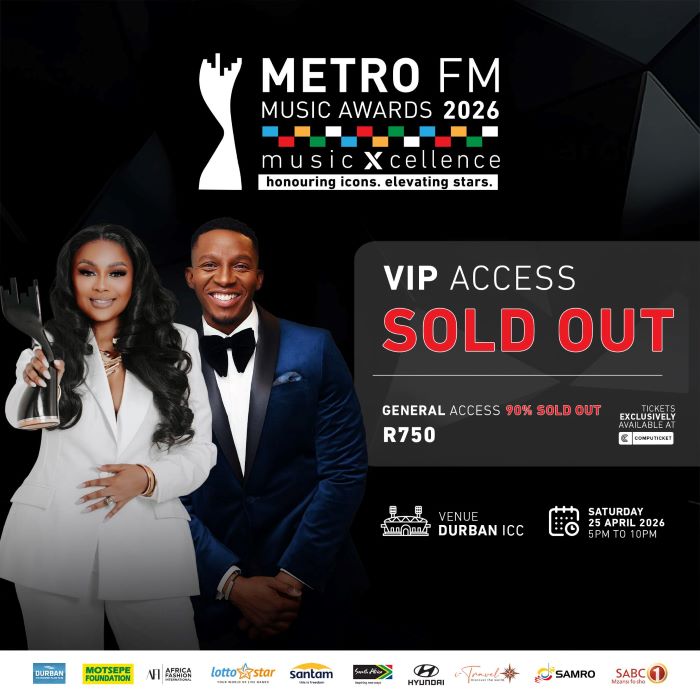
VIP SOLD OUT: R750 a ticket: The SABC keeps the ticket revenue. eThekwini ratepayers paid R20 million. The municipality can't see the books.
Tomorrow night, Durban will be a tale of two cities. While residents in informal settlements wait for water tankers and raw sewage spills into our rivers, the Municipality will spend millions on sequins and self-congratulation at the Metro FM Music Awards.The lights will be on at the ICC, but the grass remains waist-high in the parks.
The bill for the party? R20 million per year, for three years, paid by the ratepayer.
Not by the SABC, not by Metro FM, not by the Motsepe Foundation. By the eThekwini Municipality, the same municipality that told its own Council it does not have enough water tankers to give residents clean drinking water.
The Public Dispatch can today reveal the full anatomy of this deal, based on eThekwini's own responses, the Council Decision Circular and publicly available committee documents.
What these documents show is a municipality that cannot keep its own numbers straight, that bypassed competitive procurement for a R60 million commitment, and that approved an awards show budget while being told its water infrastructure is collapsing.
An anonymous events executive described the arrangement to The Public Dispatch as: "A perfect accountability blind spot. Public money goes in, but the public can't see the terms."
Six numbers. One deal. Nobody can explain.
How much is eThekwini spending on the Metro FM Music Awards?
The answer depends on which official you ask, and when you ask them.
In May 2025, the municipality said R9.5 million. That same month, Scrolla.Africa reported R25 million over three years. An Exco proposal said R30 million. In December 2025, City Manager Musa Mbhele told IOL the city had "invested R60 million." In February 2026, Portfolio Committee documents showed R20 million per year. And yesterday, 23 April 2026, the municipality's Marketing and Communications Director Mandla Nsele confirmed to The Public Dispatch: R20 million per year, R60 million total.
Nsele attempted to explain the contradictions, describing them as "distinct stages of the budgeting, negotiation, and approval processes, which is standard practice in large municipal partnerships."
But the Council Decision Circular tells a different story.
The Council resolution
The actual resolution adopted by the full Council is the document that matters.
Item 3.3.1 of the resolution granted the City Manager authority to enter into the partnership "through confirmed financial investment, media collateral and host City partnership through the confirmed available R10 Million."
Item 3.3.2 then noted that "the required financial partnership investment of R20 Million per year" would need a "shortfall in the amount of R10 Million per year" to be secured by the Chief Financial Officer "from other Clusters."
The financial implications table in the same resolution is even clearer. For each of the three years, it shows: R5 million in direct cash, R5 million in media destination promotion and leveraging. Total per year: R10 million. Total over three years: R30 million.
The return on investment table in the same Council document lists the total investment as R25 million over three years, with "Projected Exposure Value" of R60 million and a "2.4-fold return."
So the R60 million figure that City Manager Mbhele quoted to the media as the city's "investment" was never the investment. It was the projected return, an unverified number the municipality used to justify the spend. A well placed source said:
"Mbhele either confused the cost with the return, or deliberately inflated the figure. either way, the public was misled."
An internal report dated 10 November 2025 reveals the shortfall was found by raiding unspent balances in Durban Tourism and Parks, Recreation and Culture budgets. The City Manager signed off on 6 February 2026, three months after announcing a "R60 million investment" at a media launch at The Oyster Box.
R20 million in cash. Straight to the SABC.
"The Municipality’s approved annual contribution of R20 million toward the Metro FM Music Awards is structured as follows: Direct cash payment to the South African Broadcasting Corporation (SABC) and/or its appointed event management company: R20 million (cash disbursement),"Mbele told The Public Dispatch.
The R20 million per year is split between Durban Tourism (R15 million) and Parks, Recreation and Culture (R5 million). Every cent is a direct cash transfer to the SABC.
- No venue hire.
- No hospitality.
- No catering.
- No "other expenditure."
Just a R20 million cheque, posted to the SABC.
Municipal services such as:-
- security,
- traffic management,
- emergency services,
- cleaning,
- waste removal
are provided on top of the R20 million, at additional cost, under the municipality's "standard operational mandates."
The true cost to the ratepayer is therefore R20 million plus whatever it costs to deploy those services for a night. That figure is not disclosed.
DA councillor Heinz De Boer had already identified the wound. The R5 million from Parks, Recreation and Culture comes from a directorate he described as "critically underfunded," one facing "massive backlogs in terms of service delivery, grass cutting, and a shortage of equipment."
For context: eThekwini's entire Arts and Living Cultures Grant-In-Aid programme, the fund that supports community arts organisations, performing arts centres, and cultural development projects across the city disbursed R10 million in total for 2025/26.
The Metro FM Music Awards gets double that. Every year. For three years. For one night of television.
No tender and the Constitutional question.
Both the SABC and eThekwini confirm that no competitive tender was followed.
Nsele qouted Section 110(2)(a) of the Municipal Finance Management Act and Section 57(1) of the municipality's SCM Policy which reads as follows:
"This part, except where specifically provided otherwise, does not apply if a municipality or municipality entity contracts with another organ of state for the provision of goods or services to the municiaplity or municipality entity."
He said:
"Given the exclusive nature of these rights, there is no alternative supplier capable of providing the same hosting rights, and a competitive bidding process would therefore not be feasible. This argument is legally fragile and logically circular."
It is important to note that, Section 110(2) of the MFMA was designed for inter-organ-of-state procurement, situations where one municipality piggybacks on another municipality's competitively procured contract to buy the same goods at the same price.
The Eastern Cape High Court explained this provision in Blue Nightingale Trading 397 v Amathole District Municipality (2017).
The court held that for the exemption to apply,"the goods or services procured by the second organ of state are the same as that required by the first organ of state, and the contract price is the same." The agreement in that case was declared unconstitutional, invalid and unlawful, and void ab initio.
eThekwini is not procuring goods or services already secured by the SABC through a competitive process. It is paying the SABC R20 million per year to bring an event to Durban. That is a sponsorship, which the municipality's own documents call a "partnership" and a "financial investment."
The "sole supplier" argument rests on the fact that only the SABC can sell hosting rights to the Metro FM Music Awards, because the SABC owns the Metro FM Music Awards. By that logic, any entity could avoid competitive procurement by defining the requirement so narrowly that only one supplier can meet it.
Only Toyota sells Toyotas. Only Woolworths sells Woolworths food. That doesn't mean a municipality can bypass procurement to buy either.
If eThekwini's objective was economic activation through events hosting and that is exactly what its Council resolution says, the proper procurement question was not "who owns the Metro FM Music Awards?" but "which event partnership offers the best value for money against our destination marketing objectives?" There are other awards properties. There are other events. There are other ways to spend R20 million on economic activation. None of them were considered. None of them were compared.
Section 217 of the Constitution requires that when an organ of state contracts for goods or services, it must do so in accordance with a system that is "fair, equitable, transparent, competitive and cost-effective." A R20 million annual cash transfer, with no competitive comparison, no independent economic assessment, and contradictory public figures, does not meet that standard on any reasonable reading.
The black box: eThekwini pays, but cannot see the books
Here is the detail that should alarm every ratepayer in Durban.
eThekwini writes a R20 million cheque to the SABC every year. The SABC takes that money, runs the event, and collects revenue from multiple additional sources. The Motsepe Foundation, SAMRO, Santam, Lottostar, Icebolethu, Hyundai, and Africa Fashion International are all announced as sponsors or partners of MMA 2026. The awards broadcast airs on SABC1 with advertising. And the public votes via USSD at R1.50 per minute, a premium-rated revenue stream the SABC has refused to quantify, citing "confidentiality provisions."
And eThekwini has no contractual right to see any of those numbers.
Nsele's press statement is explicit:
"The SABC is not required to provide audited financial statements for the full event, including revenues from sponsorships, ticket sales, or voting platforms, as these relate to commercial activities outside the Municipality's funding scope."
The municipality funded an event it cannot fully audit. It has no contractual right to know whether the SABC made a profit, how much that profit was, or where it went.
It can verify that its R20 million was spent on "contractual deliverables" branding, media mentions, logo placement. But the commercial engine of the awards, the sponsorship revenue, the ticket sales, the voting revenue is invisible to the entity that bankrolled the show.
When The Public Dispatch asked the SABC directly about USSD voting revenue, its spokesperson Mmoni Ngubane responded:
"Commercial arrangements with telecommunications partners are governed by confidentiality provisions."
When asked for the total production cost and net commercial return of the awards, Ngubane said:
"The Corporation does not disclose commercially sensitive breakdowns relating to specific productions or events."
Public money in. Confidentiality out.
No impact assessment. Just unverified projections.
Nsele also confirmed that no independent assessment has been commissioned prior to the event.
"At this stage, no independently verified economic impact figures are available, as such assessments are conducted post-event to ensure accuracy and reliability," he said.
So, the municipality committed R20 million per year based on its own internal projections, a "2.4-fold return" and R60 million in projected exposure value without independent verification.
Those projections were presented to Council to justify the expenditure. Council approved. Nobody checked the numbers. A post-event assessment has been promised, but by then the money will have been spent. If the assessment shows the return was less than projected, there is no mechanism to claw back the expenditure or adjust future payments downward.
The deal was also negotiated entirely outside the municipality's standard Event Partnership Support Application process, the framework that normally requires applicants to submit detailed budgets, indicate local service providers, and declare all other government funding.
Nsele confirmed this and said that the agreement was "structured as a strategic event partnership" and "considered and approved by full Council."
The standard framework that ensures transparency and accountability for events funding was set aside for the single largest events commitment the municipality has made.
The water tankers and the red carpet
On the same day that eThekwini Council approved R20 million per year for the Metro FM Music Awards, 29 May 2025 the same Council agenda contained a request from the Water and Sanitation Unit for authority to spend R784.8 million on emergency vehicles.
The documents are harrowing.
The municipality's water tanker fleet "is not sufficient to meet the increasing demand for the supply of potable water through tankers." Due to "budgetary constraints," 100 hired water tankers had already been cut, leaving 166.
The municipality needed 100 new water tankers (R345 million), 300 light delivery vehicles (R227.5 million), 25 backfill trucks (R108 million), and 30 truck loader backhoes (R60 million) because plumbing teams were "idle as a result of not having vehicles" and communities were waiting days for repairs because there were not enough machines to dig.
The backfill truck shortage alone is devastating:
"Insufficient number of backfill trucks is a serious bottleneck in the turnaround time to effect repairs as plumbers cannot reopen water supply after repairs until backfilling has been done."
Residents in eThekwini cannot get clean water because the municipality cannot afford enough trucks to fill holes after pipes are fixed. And on the same agenda, the same Council approved R20 million for a television show.
ACDP councillor and eThekwini caucus leader Jameel Essop's words bear repeating:
"There is a serious governance misalignment when R20 million can be allocated to a single awards event, yet transformative grassroots sporting initiatives receive very little."
He described the allocation as "a misuse of ratepayers' money and a clear misalignment of municipal priorities" at a time when residents face "collapsing infrastructure, water shortages, sewer spillages, electricity instability, and inaccurate billing."
The DA abstained on the awards vote. The ACDP abstained. The resolution passed on ANC majority.
Tomorrow night
Tomorrow night, the Durban ICC will come alive. Lerato Kganyago and Lawrence Maleka will host. Zakes Bantwini will direct the music. Artists will walk the black carpet. Sponsors will be thanked. Trophies will be lifted. The Motsepe Foundation will fund prize money that the SABC's own Terms and Conditions do not guarantee. SAMRO, a rights organisation whose board governance is under active SAICA disciplinary investigation will be acknowledged as a sponsor.
And outside the ICC, in the townships and informal settlements of eThekwini, residents will wake up on Sunday morning to the same collapsing infrastructure, the same water outages, the same sewer spills, the same uncut grass, the same billing errors, and the same broken promises they went to sleep with.
The difference is that R20 million of their money will have been spent on a television show.
As a prominent Maskandi artist, speaking on condition of anonymity, told The Public Dispatch:
"They want our fans' airtime, but they don't want our culture on their daytime shows. We are the fuel for their red carpet, but we are still treated like guests in our own house."
The awards will be over in a few hours. The questions will not.
---NB: The eThekwini Municipality's full press statement of 23 April 2026 and the relevant extracts from the Council Decision Circular of 29 May 2025 are available in the Evidence Locker.