SA launches mobile hydrogen refuelling station at NWU
SA leads the 2026 hydrogen transition with new refuelling and training facilities at NWU to drive transport decarbonisation.
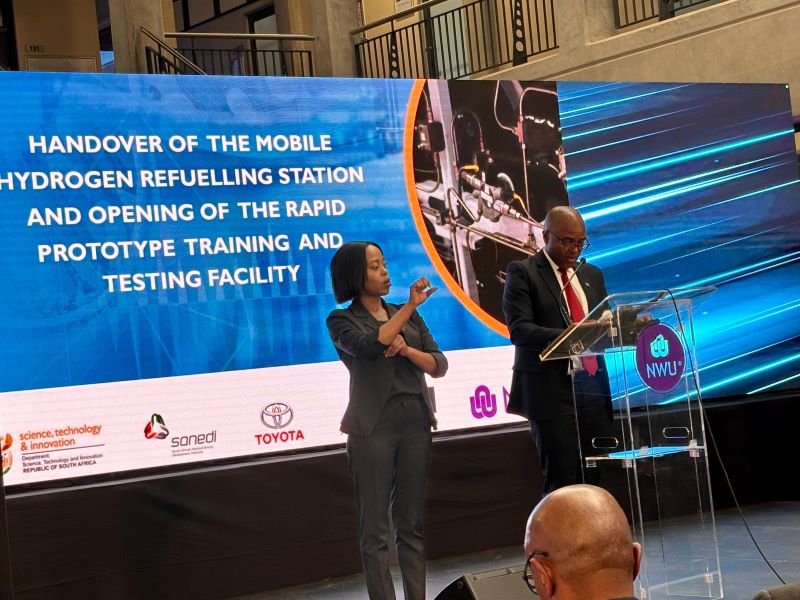
DSTI Director-General Dr Mlungisi Cele delivering the keynote address at the hydrogen mobility milestone event held at North-West University on 30 April 2026. (Image: supplied)
Just days after Freedom Day commemorations, the Department of Science, Technology and Innovation continues to demonstrate how science, technology and innovation (STI) can translate democratic gains into practical opportunities for South Africans.
On Thursday, 30 April 2026, Deputy Minister Dr Nomalungelo Gina (represented by Director-General Mlungisi Cele) officially opened the Rapid Prototype Training and Testing Facility and handed over a Mobile Hydrogen Refuelling Station at North-West University’s Potchefstroom campus in the Dr Kenneth Kaunda District.
The milestones underscore growing public-private partnerships in advancing South Africa’s hydrogen economy, skills development, and the just energy transition.
Linking freedom day to skills, innovation and economic inclusion
In her address, Gina reminded the audience that the event took place only three days after Freedom Day, which marks South Africa’s first democratic elections on 27 April 1994.
She emphasised that while political freedom was achieved through immense sacrifice, young people, who form a large part of the labour force, still face high unemployment, largely due to a mismatch between education and workplace-relevant skills.
“The opening of the Rapid Prototype Training and Testing Facility and the handover of the Mobile Refuelling Station is one of the practical examples of initiatives that have the potential to bridge the gap between education and work through innovation skills, entrepreneurship, and experiential learning,” the Deputy Minister said.
She positioned the projects as living examples of the Ministry’s motto:
“Placing science, technology, and innovation at the centre of government, education, society, and industry."
Advancing the Hydrogen Economy and Just Energy Transition
The two facilities represent significant progress in South Africa’s hydrogen ambitions.
The Mobile Refuelling Station, developed in partnership with Toyota South Africa Motors and the HySA Infrastructure Centre of Competence at North-West University, supports the decarbonisation of the transport sector, particularly heavy-duty trucks and other hard-to-abate segments.
The Rapid Prototype Training and Testing Facility, established with support from African Rainbow Minerals, will enhance skills development, translational research, and the commercialisation of locally developed intellectual property in hydrogen and fuel cell technologies.
Gina highlighted that these initiatives align with key pillars of the Decadal Plan for Science, Technology and Innovation (2022–2032), the National Development Plan, and the Hydrogen Society Roadmap (approved by Cabinet in 2021). She noted South Africa’s strategic advantage through its abundant platinum group metals (PGMs), renewable energy resources, and existing mineral base.
The projects also build on work that began in 2007 with Cabinet’s approval of the 15-year Hydrogen South Africa (HySA) Strategy.
Stronger coordination through the inter-Ministerial Committee
The Deputy Minister announced that the inaugural meeting of the Cabinet-approved Inter-ministerial Committee on the Hydrogen Economy, chaired by the Deputy President, was held on 17 February 2026. This committee aims to improve coordination across government departments and spheres to accelerate implementation of the Hydrogen Society Roadmap and related strategies.
Key objectives of the committee include creating a single point of entry for hydrogen-related engagements, enabling integrated project execution, and ensuring optimal resource allocation for catalytic projects.
Public-Private Partnerships and Skills Development
Gina acknowledged the critical contributions of North-West University, Toyota South Africa Motors, and African Rainbow Minerals. She quoted NWU Principal and Vice-Chancellor Prof Bismark Tyobeka, who described the initiative as affirming the central role of higher education institutions in the national system of innovation.
The facilities are expected to:
- Support decarbonisation of transport in line with the Hydrogen Society Roadmap
- Demonstrate commercial viability of hydrogen mobility technologies
- Integrate publicly funded IP into real-world applications
- Strengthen South Africa’s position in the global hydrogen value chain
- Create opportunities for skills development, entrepreneurship, and youth employment
Connecting rural democracy to National Innovation Agenda
This hydrogen-focused event in the North West follows closely on Deputy Minister Gina’s community engagement in Mbazwana, uMhlabuyalingana (KwaZulu-Natal) on 24 April 2026. There, she took the democracy conversation to a rural setting, using a SAPS drone demonstration and HSRC internship promotion to show how innovation delivers real services, opportunities, and change, especially for youth and elderly citizens in underserved areas.
Together, the two engagements illustrate the Department’s dual focus: bringing tangible STI benefits to rural communities while investing in high-impact, future-oriented technologies such as green hydrogen.
A defining moment for inclusive growth
The opening and handover at North-West University reinforce government’s commitment to using science, technology and innovation to address South Africa’s triple challenges of unemployment, poverty, and inequality.
By investing in skills, clean energy solutions, and collaborative innovation ecosystems, the Department aims to build a more inclusive, competitive, and sustainable economy where young South Africans can fully participate and contribute.