SABC's dirty secret: How Africa's biggest radio station discarded its own people
For years, the SABC called them independent contractors. They wore the SABC uniform. They sat in SABC studios. They used SABC equipment. They faced SABC disciplinary hearings. They built SABC audiences of millions and were forbidden from working anywhere else. Now, at least eleven of them at Ukhozi FM alone have been shown the door. South African labour law says this looks nothing like contracting. It looks exactly like dismissal.
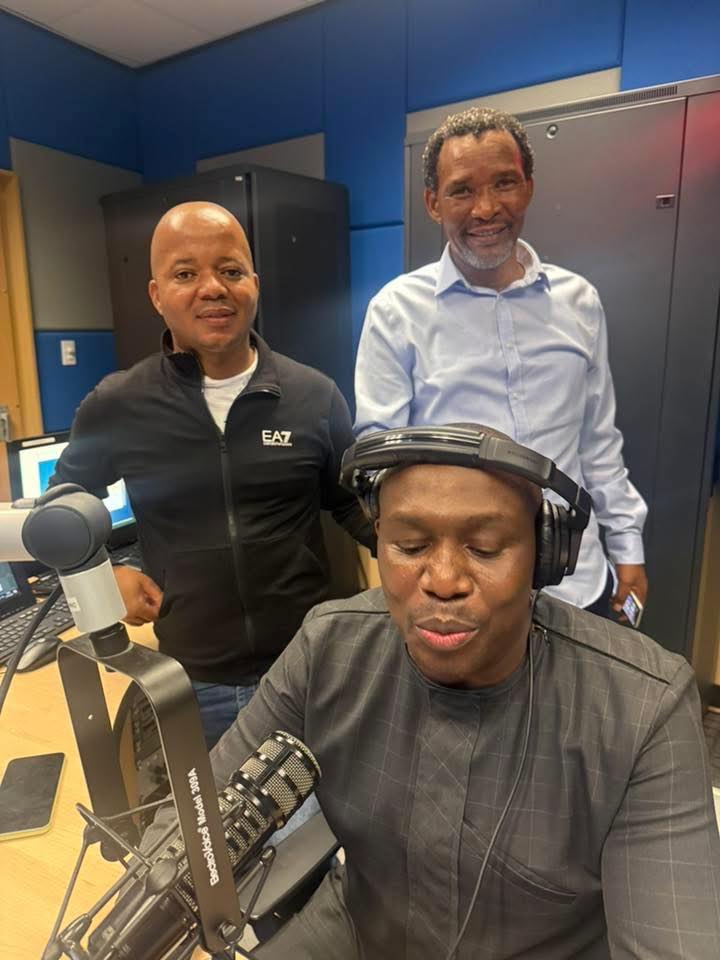
Bonga "Sphongolish" Dladla, Ayanda Msweli, and DJ Sgqemeza inside the Ukhozi FM studio. Msweli joined the station in 2004. Sgqemeza anchored the breakfast show. Sphongolish was a technical producer. The SABC said they were never employees. Then it showed them the door. (Image: Facebook)
Lucky Nkosi had been on Ukhozi FM for more than twenty years. He did not resign. He was not retired with ceremony and fanfare. Allegedly, his contract was simply not renewed.
In the language of the South African Broadcasting Corporation, he was an independent contractor whose engagement had come to an end. In the language of any honest reading of South African labour law, he was a long-serving employee who was dismissed without process, without severance, and without the dignity he was owed.
Nkosi is not alone. By the end of March 2026, at least eleven on-air personalities at Ukhozi FM, Africa's largest radio station by listenership, with over 7.5 million weekly ears, had been released as the SABC unveiled a new programming lineup.
Among them, Sipho 'DJ Sgqemeza'Mbatha, who built the breakfast show, traffic anchor Ayanda Msweli, who joined the station in 2004. DJ Zeal, who spent seven years on air, KingSfso, who co-hosted the beloved Dankie 1223 and technical producer Bonga "Sphongolish" Dladla. All of them, the SABC insists, were merely contractors.
DJ Sgqemeza was clear in his public statement, his contract was not renewed. He did not leave voluntarily. The process and communication around his departure, he said, raised concerns he felt compelled to escalate to the SABC. A man who built one of the country's most-listened-to breakfast shows was not even given the courtesy of a proper goodbye.
The Public Dispatch has spoken to the former on-air personnel at multiple SABC stations. What they describe is not a network of independent freelancers exercising professional autonomy. What they describe is a workforce kept in deliberate legal limbo, robbed of employee rights by a label, while being treated in every practical respect as employees.
It is a practice that labour law experts say is indefensible. And it is a practice, sources say, that runs across every SABC platform.
"We were employees in everything but name"
The word 'contractor' implies independence. It implies the freedom to negotiate, to work for multiple clients, to set your own terms, to walk away. None of that applied here.
"They told us we were contractors, but we could not work for any other radio station. Not one. If you were heard on a competitor's station, you were out. How is that contracting? That is control. That is employment," said a former Ukhozi FM presenter, speaking on condition of anonymity.
The exclusivity clause, whether written or implied is not an administrative quirk.
Under Section 200A of the Labour Relations Act, a person who "only works for or renders services to one person" is presumed to be an employee. That is one of seven listed factors, any one of which triggers the presumption.
The SABC's presenters did not merely satisfy one. They satisfied almost all seven presumptions.
- They worked hours dictated by SABC management. (LRA 200A(1)(b)
- They presented shows in SABC studios, on SABC microphones, using SABC software. (LRA 200A (1)(f)
- They appeared on SABC rosters. They attended SABC editorial meetings. They were integrated, completely and visibly, into the SABC's organisational machinery. LRA 200A(1)(c)
- They worked more than 40 hours a month. LRA200A(1)(d)
- They exclusively worked for SABC. LRA200A(1)(g)
A current SABC presenter at a station other than Ukhozi FM, spoke on anonymous conditions due to fear of retaliation and said:
"We sit in their offices, use their equipment, attend their meetings, answered to their managers, we even face their disciplinary hearings and they still don't see us as employees. It's exploitaion of workers, an unfair labour practise and theft of labour which has been going for years."
You can call it a contract. The law calls it employment.
South African labour law does not defer to labels. It looks at reality. The Labour Relations Act and the Basic Conditions of Employment Act are explicit: the form of a contract does not determine whether someone is an employee.
What determines it is the nature of the relationship. The courts have said this repeatedly. The Labour Appeal Court said it directly in the landmark case of SABC v McKenzie, a case involving, with devastating irony, the SABC itself.
In this case the court held that the legal relationship must be gathered from the realities of the arrangement, not from what the parties chose to call it.
A labour law practitioner with knowledge of the broadcasting sector, spoke on condition of anonymity and said:
"The SABC has been playing this game for a very long time. They know exactly what they are doing. The contractor label is not a mistake. It is a strategy. It saves them from paying UIF, from paying severance, from following dismissal procedures. It costs these workers everything and costs the SABC nothing."
Disciplinary hearings for people who were never employees
Perhaps, the most brazen aspect of the SABC's arrangement is this: it subjected its so-called independent contractors to formal disciplinary hearings.
In 2022, the SABC terminated the contract of Ukhozi FM's Sibusiso "Sbu" Buthelezi. The broadcaster issued a formal statement saying it had "decided to terminate his contract as an Independent Contractor with immediate effect" following "allegations relating to his business dealings that brought the organisation into disrepute." A disciplinary process. For a contractor. Using the language and machinery of employment.
You cannot have it both ways. You cannot invoke the authority of an employer to discipline someone and then disclaim the obligations of an employer when it comes to their rights. The law does not permit that contradiction and the SABC has been living inside it for years.
"I was called to a disciplinary hearing. I sat across from SABC managers. I was warned, I was suspended, I was threatened with termination, all while being told I was not their employee. I did not know whether to laugh or cry," a former SABC television presenter revealed.
This is not an Ukhozi FM Problem. This is an SABC problem.
The public outrage that has followed the Ukhozi FM departures has been framed, largely, as a story about one station. It is not. The Public Dispatch has confirmed that the same practice, classifying on-air and production staff as independent contractors while exercising full employer control over them is replicated across SABC radio and television platforms nationwide.
Metro FM, Umhlobo Wenene FM, Lesedi FM, SABC News. The pattern is the same. Years of service, total dependence, complete control and a contract that says "independent contractor" so the SABC does not have to pay what the law would otherwise require.
"It is the same story everywhere in the SABC. Same contract, same conditions, same control, same story when they no longer need you. You are out and you have nothing. No severance. No UIF. Nothing. Because on paper, you never worked there,"said a current SABC presenter outside KwaZulu-Natal, speaking on condition of anonymity.
The legal crossfire: Nowhere left to hide
The legal tide is turning against arrangements exactly like this one.
In January 2026, the Department of Employment and Labour published Government Gazette No. 53987, proposing to deem performers in artistic and cultural activities including broadcasting as employees for the purposes of the Basic Conditions of Employment Act, the Labour Relations Act, and the National Minimum Wage Act. The notice makes explicit what labour lawyers have long argued, calling someone a contractor does not make them one. The label is not the law.
The financial exposure for the SABC, should these relationships be reclassified, is enormous.
- Unpaid UIF contributions.
- Back PAYE obligations.
- Potential unfair dismissal awards for each affected presenter.
- Severance pay for years of continuous service.
Multiply that across every SABC platform, across every season, across every presenter who was ever handed a contractor agreement and told to sign and the liability is staggering.
- Section 23 of the Constitution of the Republic of South Africa guarantees every person the right to fair labour practices. Not every employee but every person. The SABC is a public entity. It is funded by the public. It is mandated to serve the public interest. And it has, for years, used a legal fiction to deny some of its most loyal and productive workers this right.
This is not a story about radio lineups. It is not a story about one station losing some familiar voices. It is a story about an institution that chose, deliberately and consistently, to exploit the people who made it great. The SABC owes these workers more than a non-renewal notice. It owes them an accounting before the CCMA, before the Labour Court, and before the South African public
This was not an administrative error. This was a deliberate, sustained, institution-wide policy of labour exploitation dressed up in contractual clothing.
A debt that must be paid
The SABC thinks they have closed the door on these contracts. In reality, they have opened a floodgate of liability. Every hour of unpaid overtime, every cent of unpaid severance, and every 'dismissal' conducted without the due process required by the LRA is a debt that will eventually be called in.
Lucky Nkosi did not deserve a cold letter of non-renewal. He deserved the protection of the laws of this land. The SABC has treated its stars like rented equipment, to be used until they are worn out and then discarded without a second thought.
The microphones may have been turned off for these icons, but the noise of this legal battle is only just beginning. The SABC owes an accounting to the workers, to the law, and to the 7.5 million people who now know the ugly truth behind the "independent" mask.
"These people gave everything, their voices, their time, their careers. They could not work elsewhere, they depended on the SABC and then one day SABC just decided to get rid of them. No acknowledgement of what they built, it is shameful," a source with direct knowledge of multiple presenter departures
The SABC's reponse: a masterclass in saying nothing
The Public Dispatch presented the SABC with a comprehensive questions. The SABC’s response was a deafening silence. This silence isn't just a PR failure, it is an admission of guilt.NB: Please visit our Evidence Locker to view the full case of SABC v McKenzie and the specific legislative documents including Government Gazette No. 53987, Labour relatoins Act and the Constitution of the Republic of South Africa proving the law is no longer on the SABC's side