Science and innovation take democracy to Mbazwana's doorstep
Deputy Minister Gina brings Freedom Month conversation to one of KwaZulu-Natal's most rural corners and leaves behind more than just a speech.
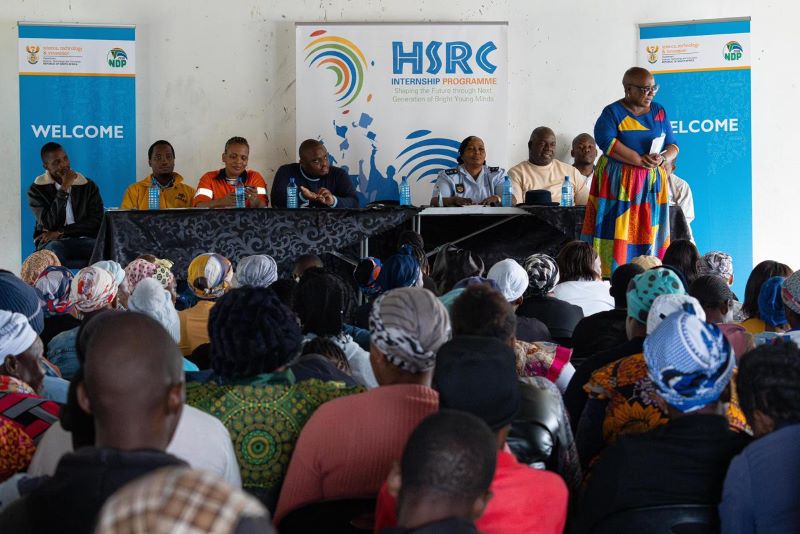
Deputy Minister Gina takes the democracy conversation to Mbazwana, showing how innovation can deliver real services, real opportunities, and real change in uMhlabuyalingana (Image: supplied)
Nearly 250 residents of Mbazwana and surrounding areas gathered at Oqondweni Hall on Friday, 24 April, for a community engagement that was, by any measure, unusual for a municipality where more than half the population never finished secondary school.
The Deputy Minister of Science, Technology and Innovation, Dr Nomalungelo Gina, came to uMhlabuyalingana not just as a minister but as the area's Parliamentary constituency officer and as the government's champion of the District Development Model in uMkhanyakude.
Thirty years of democratic investment in science
The engagement formed part of national Freedom Month commemorations, and Gina used the occasion to reflect on what South Africa has built since 1994. Democratic government, she argued, has invested in science and technology as instruments of transformation not as abstract policy goals, but as practical levers for inclusion and development.
"Access to scientific knowledge, innovation and opportunities is essential for participating fully in our democracy, and for building a more equal and prosperous society," she told the gathering.
She pointed to digital social grant infrastructure as one example, a system that now delivers payments to millions of citizens efficiently and with greater financial inclusion than was possible under paper-based administration.
The message was deliberate, that innovation, properly directed, reaches people where they are.
A drone over Mbazwana
Perhaps the most striking moment of the day came when Warrant Officer Owen Howard, a provincial SAPS drone pilot, flew a Matrice M30, a professional-grade drone equipped with wide, zoom and thermal cameras, and a laser rangefinder.
"Years ago, the SAPS did not have this technology to locate a missing person in the bush. Now we can use thermal imaging to help find missing persons without immediately deploying a helicopter," said Howard.
For a municipality that stretches across remote terrain and where search-and-rescue capacity has historically been limited, the demonstration was more than a technical showcase. It was a glimpse of what modern policing tools can mean in a rural context.
Research that puts people first
The Human Sciences Research Council (HSRC) was also present, represented by IT expert Mr Nqubeko Mbhele, who explained how social research informs government service delivery in health, education, safety, employment, and social support.
"From visiting households across the country to strengthening community voices, the HSRC continues to ensure that democracy works for the people by putting their lived experiences at the centre of decision-making," Mbhele said.
The HSRC also promoted its graduate internship programme, which has placed more than 7,000 unemployed graduates in workplace and research settings since 2005, across science, engineering, technology, humanities and the social sciences. Mbhele encouraged local youth to pursue further education so they too could benefit.
Community voices
Community member Lindiwe Mabika, whose immediate focus is continuing her studies in primary health, said the engagement gave her a clearer sense of direction.
"The information I received today will help me plan for a better future for myself. I am also grateful to have known about the HSRC internship programme. Hopefully, I will be one of its beneficiaries in the future," she said.
Senamile Khumalo, 36, who works with Heifer Project South Africa (HPSA), welcomed the engagement as the kind of exposure that rural communities rarely get. She was especially encouraged by the discussion of government initiatives to protect young people and the elderly, and used the platform to invite local youth to join HPSA, an organisation that trains rural young people in livestock management and agricultural business development.
"Communities benefit when they are exposed to information and support needed most," she said.
A municipality that needs investment
uMhlabuyalingana Local Municipality covers 361 km² in the north-eastern corner of KwaZulu-Natal, with a population of approximately 163,694 people. It is largely rural and heavily dependent on subsistence farming, with fruit processing and livestock production as the main economic activities.
The education statistics are stark: 18% of residents have had no formal education at all, 57% did not complete Grade 12, and only 8% have matric or higher. Against that backdrop, the HSRC internship pitch and Dr Gina's emphasis on science and technology as pathways to employment carry particular weight.
Alignment as a development strategy
Gina's visit was also a function of her specific mandate in the area. As Parliamentary constituency officer for uMhlabuyalingana and District Development Model champion for uMkhanyakude, her role is to align national, provincial and local government plans, to ensure that infrastructure delivery, job creation and rural development do not fall through the cracks between spheres of government.
The Friday engagement, she said, gave her direct insight into how science and technology are — and are not — being used at the local level, and what more needs to be done.
Partner institutions at the event also included the Department of Justice and Constitutional Development, the Department of Social Development, the Independent Electoral Commission (IEC), and the South African Police Service.