SHAMELESS: Sacked NAC Council demands return to office but fail to return state-funded iPhone 17s
Dissolved NAC Council splits: Some members threaten court but their own former Chairperson won't join and questions the "Urgent" challenge
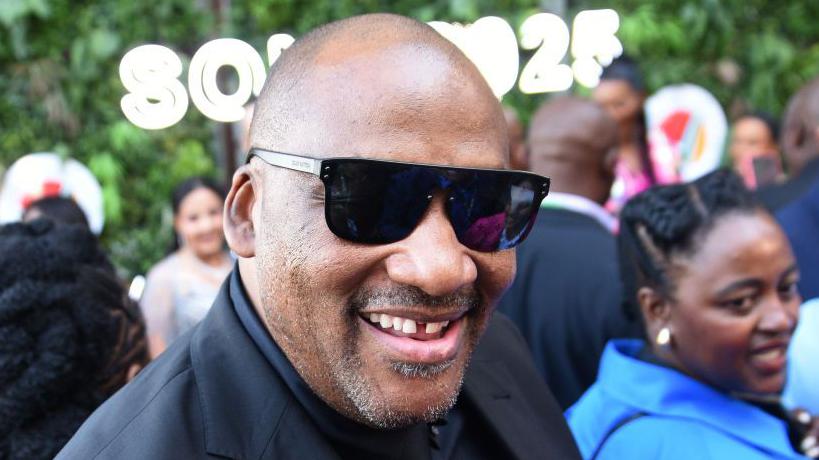
Slamming the door on entitlement: Minister Gayton McKenzie, who dissolved the dysfunctional National Arts Council board, now faces hollow legal threats from axed members.
Two stories, one aftermath
A month after Minister of Sport, Arts and Culture Gayton McKenzie dissolved the National Arts Council board on 25 May 2026, the consequences are unfolding on two fronts at once.
On one front, some former council members are fighting their removal, threatening the Minister with urgent litigation and demanding reinstatement. On the other, the government has confirmed in Parliament that 14 devices issued to former council members at public expense have still not been returned.
Taken together, the two developments capture the strange position the dissolved council now occupies: simultaneously demanding to be restored to office, and yet to account for the public assets handed out under its watch.
The legal challenge
Several former members of the National Arts Council have threatened to take McKenzie to court over the dissolution. According to Africa Daily on 23 June 2026, the former members are represented by Mphahlele and Masipa Inc. Attorneys. In a letter dated 3 June 2026, the attorneys described the Minister's decision as unlawful and demanded its immediate withdrawal.
The former members have demanded that McKenzie withdraw the dissolution, rescind the termination of their appointments, reinstate them, and suspend any process to appoint a replacement council, interim council, or administrator. They gave the Minister five calendar days to confirm in writing that he would comply, failing which they said they would institute urgent court proceedings.
What the former members argue
The legal challenge does not dispute the underlying facts. It attacks the process.
The central contention is that the former members were not afforded a fair hearing before their removal. According to the attorneys, there was no notice that their appointments were under threat, no invitation to make representations, no disclosure of the specific allegations against them, and no opportunity to respond before the dissolution took effect.
The attorneys also raise a point of some force regarding the timeline. The Minister had directed the council in April to convene a special meeting to resolve the bonus dispute. The council scheduled that meeting for 29 May, and governance structures including the Audit and Risk Committee had reportedly begun preparing reports. But the council was dissolved on 25 May, four days before the meeting could take place.
In the attorneys' words, the council "was criticised for failing to complete a process which it had been instructed to undertake, whilst simultaneously being denied the opportunity to complete that process."
They further argue that no investigation was conducted into individual members, and that no findings of dishonesty, financial misconduct, gross negligence, or breach of fiduciary duty were made against any individual before the dissolution.
The argument has merit but there's also a significant weakness
The process argument is not frivolous. South African administrative law, under the Promotion of Administrative Justice Act, generally requires that administrative action affecting people's rights be procedurally fair. The principle that a person should be heard before an adverse decision is taken against them is foundational.
If individual members were removed without any opportunity to respond, a court may consider that aspect worth examining. But there is a significant weakness in the challenge, and it sits in the statute the Minister relied upon.
Section 5(5) of the National Arts Council Act, as amended by the Cultural Laws Amendment Act of 2001, empowers the Minister to dissolve the council "on any reasonable grounds." That is a deliberately wide power. The Minister dissolved a collective governance body not individual employees facing disciplinary charges.
The dissolution of a board for collective governance failure is legally distinct from the dismissal of an individual for personal misconduct.
The first generally requires reasonable grounds, the second requires a disciplinary process. The Minister's dissolution letter set out his reasons in detail, a prolonged failure to resolve the bonus dispute, legal costs that exceeded the value of the claims, and procurement concerns including the mobile devices and external recruitment fees. Whether those amount to "reasonable grounds" is precisely the question a court would weigh.
But reasonable grounds is a far lower bar than the proven individual misconduct the attorneys' letter appears to demand.
Botha stands firm and casts doubt on the challenge
When The Public Dispatch put the legal challenge to former Chairperson Eugene Botha directly, his response settled one question and raised another. Botha confirmed he is not part of the litigation and that his earlier position is unchanged.
"I stand by my comments and I have nothing to return. I'm not party to any litigation against the Department."
The man who chaired the dissolved council still accepts the Minister's decision and is not among the former members now threatening court action. When The Public Dispatch first contacted Botha after the dissolution in May, he had said:
"I respect the Minister's decision and I do not intend to contest it. The Minister's letter sets out his reasons, and it speaks for itself."
A month later, that position stands. Botha also clarified, for the record, that he never received an NAC device at all.
"I did not need a device so I never requested one," he said.
He is therefore not among the former council members who have yet to return NAC,issued devices. That detail is quietly telling. If the chairperson of the council, the person at the very top of the governance structure, managed his duties without ever requesting a device, it raises the question of why some devices were procured for council members at all.
But Botha went further, and in doing so cast doubt on the seriousness of the challenge mounted by his former colleagues.
"It seems really strange to me, as an Attorney, that a letter threatening urgent action was sent on 3 June and more than 20 days later there is no court order,"he said.
The observation carries weight precisely because of its source. In South African law, urgency is not a rhetorical flourish, it is a specific legal standard. A party seeking urgent relief must show that they cannot obtain substantial redress in the ordinary course, and must act with corresponding speed. A letter threatening urgent proceedings, followed by more than three weeks of silence, invites exactly the question Botha raises: if the matter was urgent on 3 June, why has no court been approached more than 20 days later?
The vacuum has already been filled
There is a further problem for the former members' challenge, and it concerns timing.
One of their central demands is that the Minister "suspend any process to appoint a replacement council, interim council, or administrator." But that step has, in effect, already been taken. On 12 June 2026, the NAC announced that Minister McKenzie had seconded Lebogang Mogoera as Acting Chief Executive Officer and Acting Accounting Authority of the NAC. In the words of the official statement, the appointment
"follows the Minister's decision to dissolve the NAC Council on 25 May 2026 and serves to ensure governance continuity, institutional stability and uninterrupted services."
The significance of this is easy to miss but considerable. By designating an Acting Accounting Authority, the Minister has filled the governance vacuum the dissolution created.
Under the Public Finance Management Act, the accounting authority is the body legally responsible for an entity's finances and governance, the role the dissolved council previously held. With Mogoera now exercising that function, the NAC once again has a lawful authority able to approve funding decisions, sign a settlement of the bonus dispute, and oversee the recovery of the outstanding devices.
This appointment was announced within days of the attorneys' 3 June letter demanding that no such appointment be made. The former members are therefore seeking to halt a process that has already concluded, and to reclaim a governance role that is now occupied by a Minister-appointed official. A court asked to reinstate them would have to grapple not with a vacuum, but with a functioning accounting authority already in place.
Meanwhile, devices remain missing
While some former members fight to return to office, the government has confirmed that the council's exit has left unfinished business, specifically, the unreturned devices.
On 5 June 2026, EFF MP Eugene Mthethwa submitted a written parliamentary question to the Minister, asking whether all devices issued to former NAC council members laptops, tablets, and smartphones had been retrieved following the dissolution.
The Minister's written reply, now on the parliamentary record, confirms what this publication has reported since May, that devices have not been retrieved.
The "Buy It Instead" option deserves scrutiny
The most striking element of the reply is the choice the NAC is offering former councillors.
"The NAC has communicated with the affected former Council members and has afforded them until the end of the current month to either return the devices or purchase them at the applicable asset value."
Former council members, people who ceased to hold office over a month ago, whose devices were procured with public money for governance work that no longer exists are being given the option to simply buy the devices instead of returning them. On its face, selling a depreciated asset to the person already holding it can recover some value for the public purse. That is a legitimate disposal mechanism in principle.
But several questions arise that the reply does not answer. What is 'the applicable asset value'? Is it the original purchase price, a depreciated book value, or fair market value? what figure is actually being charged? Was this purchase option approved through a disposal process compliant with Treasury Regulation 16A7, which governs the disposal of state assets?
Disposal of public assets is not a matter of administrative convenience, it requires a documented process, often including a determination that disposal by other means, such as public auction, would not be more advantageous to the state.
Is the purchase price being paid into the NAC's account and properly recorded as revenue? And is this option being offered to every former member equally, including the one previously identified by this publication as having resigned approximately a month before the dissolution, and having therefore held a state asset without any work-related justification for an extended period?
The money still sitting in private hands
The timeline is worth pausing on. The council was dissolved on 25 May 2026. The work-purpose justification for every device ceased that day. A full month later, devices worth potentially R20,799 to R52,499 each remain in the possession of private citizens who have had no official capacity at the NAC for a month. At the upper end of the pricing range, devices represent up to R734,986 of public money currently held by people with no continuing entitlement to it.
A Council that could never speak with one voice
Place the two developments side by side and a single picture emerges. McKenzie dissolved the council in part because it could not act decisively or cohesively on a single, time-sensitive instruction. A month later, that same body cannot present a unified position even on its own removal. Its former chairperson accepts the dissolution and questions the litigation. Some of its former members are threatening court action through their attorneys.
There is no single voice, no collective stance, no coherence not on the dissolution, and not on the assets. The council the Minister described as unable to act as one has, in dissolution, proven exactly that.
The institution has already moved on, a new accounting authority is running it while the former members fight to return.
The Stakes for the Sector
While the legal manoeuvring unfolds, the practical consequences fall, as ever, on artists. The demand to suspend any process to appoint a replacement council is the most consequential element of the challenge. If the former members obtained an interim court order halting the appointment of a new council or administrator, the NAC could be left in extended governance limbo no dissolved council and no new council.
That uncertainty arrives at a critical moment. The PESP 7 funding window has closed, and thousands of artists await adjudication and funding decisions that require a properly constituted accounting authority to approve. The bonus dispute that triggered the entire crisis still requires a settlement agreement signed by an authorised representative of the NAC. A protracted legal battle over the dissolution does not serve the artists this institution exists to support. It serves the interests of those fighting to reclaim their positions.