South Africa puts hydrogen on wheels
A mobile hydrogen refuelling station and a rapid prototyping facility mark a concrete step forward in South Africa's bid to build a green hydrogen economy
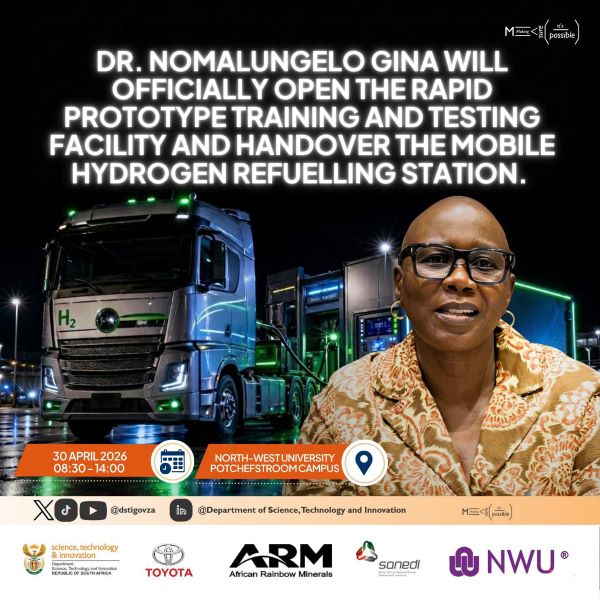
Deputy Minister of Science, Technology and Innovation Dr Nomalungelo Gina will hand over the Mobile Hydrogen Refuelling Station at North-West University's Potchefstroom Campus. (Image: DSTI)
Deputy Minister of Science, Technology and Innovation Dr Nomalungelo Gina will on Thursday, 30 April, officially open the Rapid Prototype Training and Testing Facility and hand over the Mobile Hydrogen Refuelling Station at North-West University's Potchefstroom Campus.
A station built on local knowledge
The Mobile Hydrogen Refuelling Station was completed in February 2025 through a partnership between the HySA Infrastructure Centre of Competence and Toyota South Africa Motors. It is designed to demonstrate hydrogen fuel cell electric vehicle technologies in a practical, mobile setting and critically, it showcases intellectual property developed locally.
South Africa's hydrogen ambitions have long been shadowed by the question of whether the country will be a raw materials supplier or a technology player. A locally developed refuelling station, handed over at a university campus, is a small but deliberate answer to that question.
What happens inside the Rapid Prototyping Facility?
The Rapid Prototyping Training and Testing Facility, a partnership between the Department of Science, Technology and Innovation (DSTI), North-West University, and African Rainbow Minerals is designed to do the unglamorous but essential work of moving hydrogen technology from the lab to the real world.
Its focus includes green hydrogen production, component innovation, system integration, and scaling technologies from laboratory to pilot and eventually industrial applications. In other words, it is where ideas become infrastructure.
The bigger picture
Both facilities fall under DSTI's Energy Research, Development and Innovation Flagship Programmes, which span renewable energy, energy storage, hydrogen development through the HySA programme, and carbon capture and use.
They also sit within the framework of South Africa's Hydrogen Society Roadmap and the country's Just Energy Transition commitments, the effort to move away from coal dependence without leaving mining-dependent communities behind. The transport sector, one of the harder sectors to decarbonise, is a key target.
The handover on Thursday is a milestone. It is not the finish line.