VBS linked company receives R124millon tender from Justice Department
Tshifhiwa Matodzi used Brilliantel (Brilliant Telecommunications) to gain entry into VBS Mutual Bank.
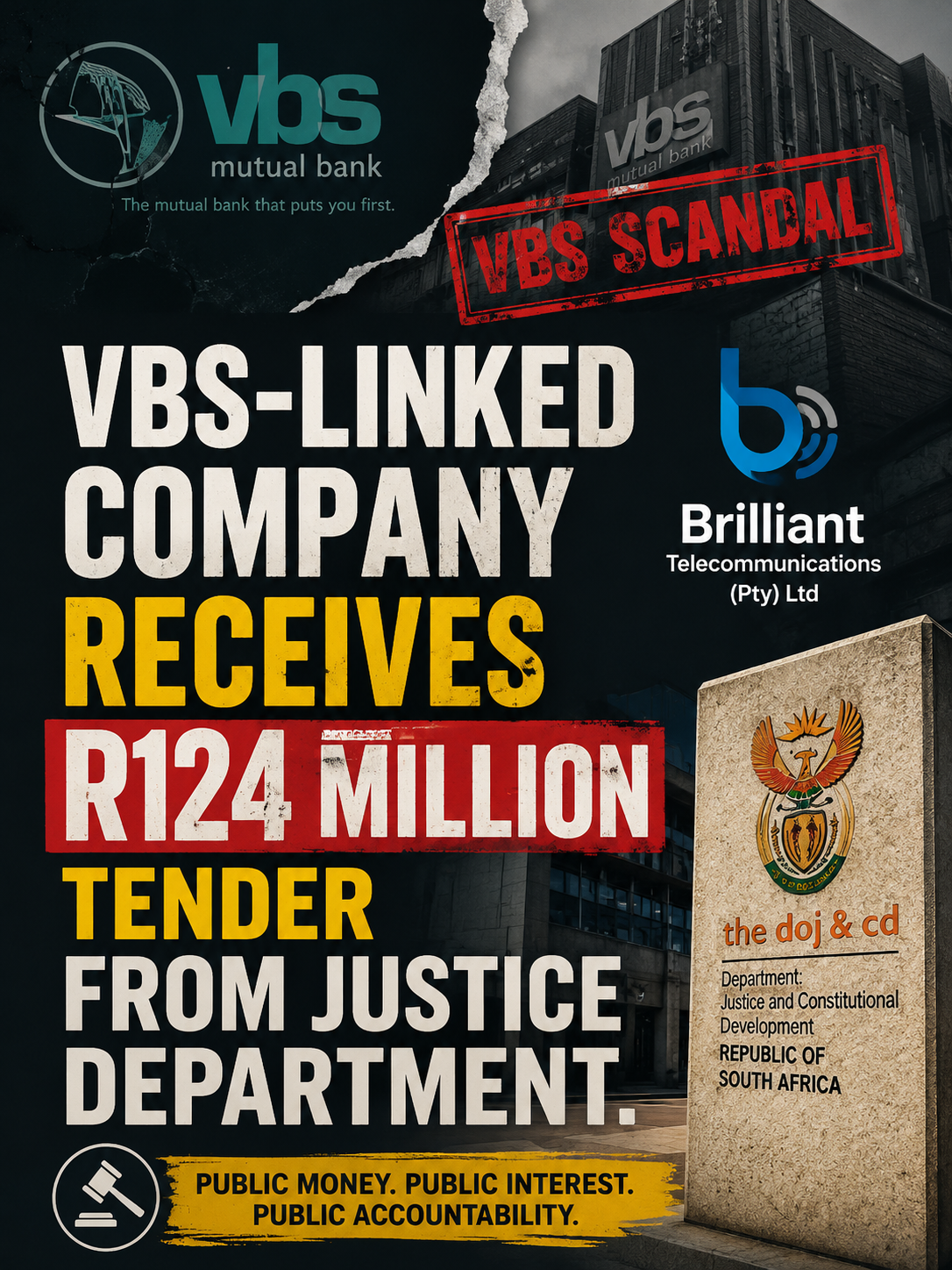
The Department of Justice and Constitutional Development has approved more than R124 million in technology contracts for Brilliant Telecommunications. (Image: AI Illustration)
The Department of Justice and Constitutional Development awarded over R124 million to Brilliant Telecommunications, the company once used by convicted VBS kingpin Tshifhiwa Matodzi without conducting any meaningful due diligence on the supplier’s history.
When asked whether it knew it was paying this money to a company linked to the man at the centre of one of South Africa’s biggest financial scandals, the department offered no clear answer.
The awards relate to three separate projects with a combined value of R124.7 million. These include:
- Four datacentre network core switches;
- A network upgrade at 65 Justice Department sites nationwide; and
- Firewall licence renewals and support services.
How does Brilliant Telecommunications (Pty) Ltd link to VBS scandal?
Matodzi was one of the directors in Brilliantel (Brilliant Telecommunications). He acquired a 45% stake in Brilliantel in 2005 and became a director the following year (2006).
Brilliantel contributed R3 million in seed capital to establish another company called Dyambeu Investments, alongside other investors involved in the transaction. In total they contributed R6 million to establish Dyambeu Investments.
This new company, (Dyambeu Investments) used the seed funding (R6 million) to purchase a 26% stake in VBS Mutual Bank. This large shareholding helped Matodzi to get a board seat at VBS. In July 2015, Matodzi was appointed Chairperson of VBS’s board.
This structure gave Matodzi significant influence and credibility within Venda/Limpopo networks.
R2 billion looted during his tenure
During his tenure, about R2 billion was looted. The money belonged to ordinary people, grandparents, families, and small towns who had saved it there. They trusted the bank, and the money disappeared. He was eventually arrested and in July 2024 the Gauteng Division of the High Court, Pretoria found him guilty. He was sentenced to 15 years in prison.
And now, (less than two year) the government has appointed the same company to the job.
This publication is not suggesting that Brilliant Telecommunications was involved in the looting of VBS, nor is it suggesting that Matodzi remains involved with the company today.
What it is saying is that Brilliant Telecommunications is not just another name on a government supplier database. It is a company whose history intersects with one of South Africa's biggest financial scandals.
That history alone does not prove wrongdoing by the company. But it is a history that should prompt scrutiny. It is a history that should lead decision-makers to ask questions. And it is a history that makes it reasonable for the public to expect that those questions were asked before more than R124 million in public contracts were approved.
Department of Justice and Constitutional Development defends the tender
When The Public Dispatch first looked at this deal, it looked highly suspicious. Three massive contracts were given to a single company.
They were published on Thursday, 28 May 2026, and closed less than 24 hours later on Friday, 29 May. On top of that, they were tagged with a Department of International Relations (DIRCO) contract number, even though the work was for the Justice Department.
Samuel Modipane from DOJ said this was not a normal, fresh public tender. Instead, the department used a legal loophole called Treasury Regulation 16A6.6. This rule allows one government department to piggyback on a contract that another department has already went out to a competitive public tender for.
"The Department utilised the participation mechanism provided for in Treasury Regulation 16A6.6 of the Public Finance Management Act, which permits an organ of state to participate in a contract arranged through a competitive bidding process by another organ of state, subject to the approval of both the originating organ of state and the relevant contractor," explained Modipane.
Modipane said that DIRCO had already awarded a 5-year contract to Brilliant Telecommunications back in July 2022. The 24-hour notice was just a public notice published after the deal was already done.
"Prior to approving participation under DIRCO Contract 02-2021/2022, the Department satisfied itself that the host contract had been established through a competitive bidding process and that the requisite approvals had been obtained from both the Department of International Relations and Cooperation (DIRCO) and Brilliant Telecommunications (Pty) Ltd," said Modipane.
Four critical questions, one recycled sentence
We asked the department six specific questions about the company itself and the checks done before giving them R124.6 million. Four of those questions came back with the exact same sentence, copied and pasted word-for-word:
"The Department's assessment of the participation arrangement was undertaken in accordance with the applicable public procurement prescripts, including Treasury Regulation 16A6.6, and was based on the requirements prescribed therein."
- It used this sentence to dodge whether it checked the company’s ownership and legal history.
- It used this sentence to dodge whether it knew about the company's deep ties to the VBS bank heist.
- It used this sentence to dodge whether it knew about a court battle in Pretoria over the company's technical qualifications.
- It used this sentence to dodge a basic request to list the company's current directors and shareholders.
The confession hidden in the evasion
While trying to defend itself, the department admitted that it verified the supplier on the government's central database and checked its tax compliance. Then it added that it "did not undertake a separate procurement process or a stand-alone due diligence exercise,"
"...the Department performed the standard supplier verification processes applicable to public procurement, including verification of the supplier's registration status on the Central Supplier Database (CSD), tax compliance status and other compliance requirements prescribed by the applicable supply chain management prescripts. The Department did not undertake a separate procurement process or a stand-alone due diligence exercise beyond the requirements applicable to participation in an existing contract concluded by another organ of state," he said.
This is an admission of blind procurement.
The department checked that the company’s paperwork was technically active. It did not look into who actually owns the company, who has run it in the past, or how it behaved in previous government deals. For a R124-million commitment of public funds, the department’s only defense is: the computer system gave it a green tick.
This complete failure to check the reputation and ownership of a supplier should deeply worry anyone who remembers the VBS scandal.
What we still don't know
The Department of Justice proved that the legal loophole it used exists. It has completely failed to prove that it knew or cared to find out who it was actually paying.
Those are two very different things. The gap between doing legal paperwork and doing real background checks is exactly where billions of rands of public money have gone missing before. Three important questions still hang over this multi-million rand deal:
Does a massive IT upgrade at 65 different local courts actually fit inside a connectivity contract signed by DIRCO four years ago, or are they stretching the rules?
Did anyone in the approval chain notice the company's VBS history and sign the check anyway?
And if everything was done perfectly by the book, why won't the department release the documents to prove it?
We sent a detailed list of questions to Brilliant Telecommunications. To date, the company has not responded to our questions.