One company bags R70 Million as housing swallows nearly half of eThekwini's R466 Million tender bonanza.
An analysis of eThekwini Municipality’s April 2025 tender awards reveals that a single contractor secured over R70 million across three separate housing projects roughly a third of all high-value Human Settlements spending raising urgent questions about competitive spread and procurement transparency.
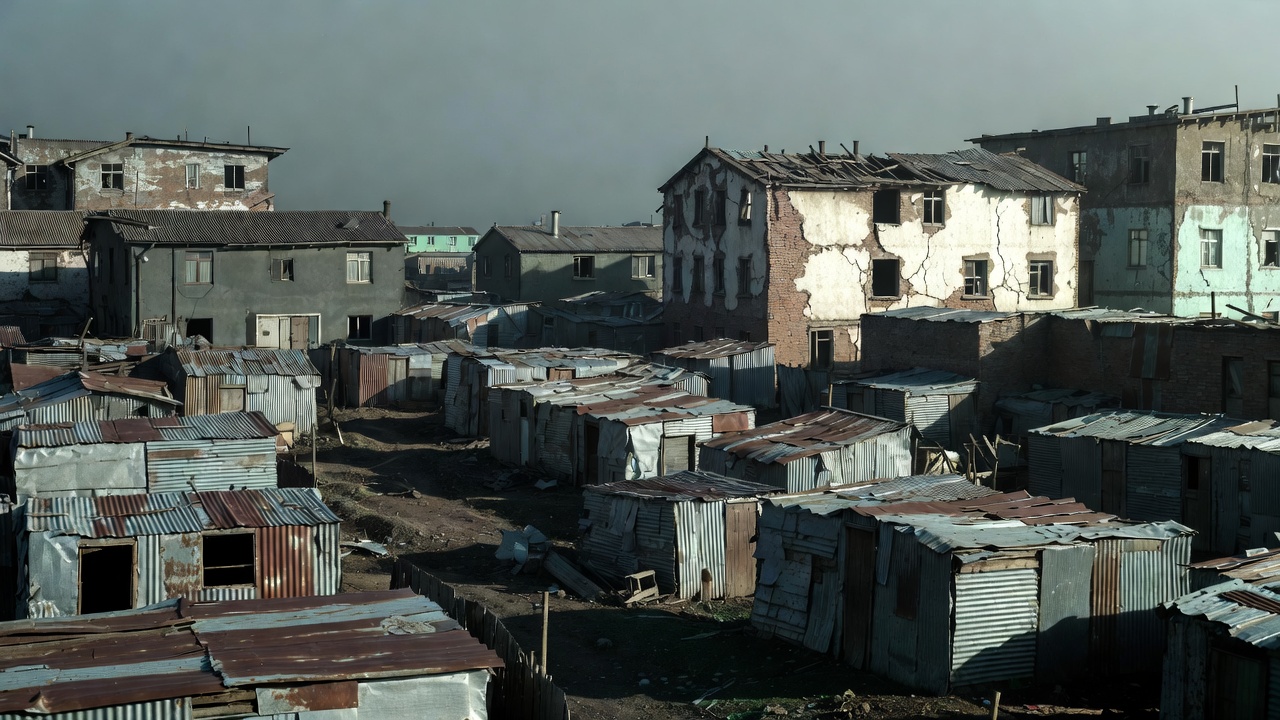
Dilapidated shacks and crumbling RDP structures persist while eThekwini awards R466.3m in high-value contracts. Nearly half to Human Settlements, with one firm taking R70m across three projects.
EThekwini Municipality awarded approximately R466.3 million in contracts exceeding R10 million in its April 2025 public tender report. Nearly half that amount flowed into a single department , Human Settlements and a significant portion of that landed with one company.
A close reading of the municipality’s published award register reveals a pattern of repeated beneficiaries, concentrated housing allocations, and a striking asymmetry between what is disclosed and what remains hidden from public scrutiny.
Housing swallows half the budget
Of the R466.3 million in high-value contracts, approximately R220.1 million, around 47% was directed to Human Settlements projects alone. The housing portfolio covered a broad geographic spread across eThekwini, including:
- • Construction of 300 pre-1994 housing units.
- • Zwelibomvu Rural Housing: 200 units split between two contractors.
- • Embo Rural Housing: 210 units split between two contractors.
- • Klaarwater Community Residential Unit (CRU) infrastructure works.
- • Planning and SPLUMA approvals for Umlazi Part 6.
The largest individual award in the housing portfolio went to Dream Community SA (Pty) Ltd, which secured R40.6 million for infrastructure works at the Klaarwater CRU. But it is not that contract that defines the story.
One company, three contracts, R70 Million.
RGZ Projects (Pty) Ltd emerged as the dominant repeat beneficiary in this cycle. The company was awarded three separate housing contracts within the same reporting period:
- • R36.9 million for the construction of 300 pre-1994 housing units.
- • R16.47 million for Zwelibomvu Rural Housing (100-unit allocation).
- • R17.5 million for Embo Rural Housing (105-unit allocation).
Combined, RGZ Projects secured approximately R70.88 million in a single award cycle. That represents roughly 32% of all high-value Human Settlements spending reported for April 2025.
The projects are geographically distinct and not identical in scope. But the scale and repetition of allocation to a single contractor within one reporting window is notable and raises legitimate questions about concentration risk, competitive spread, and the depth of the bidder pool.
Split awards and a narrow field.
Several housing projects were divided between two contractors, a common approach in large-scale housing delivery aimed at distributing workload and risk. At Zwelibomvu and Embo, each project was evenly split into 100- and 105-unit allocations respectively, with two companies sharing the work on each site.
What is notable is that RGZ Projects appears on both split-award projects, suggesting the company either consistently outperformed competitors across multiple evaluations, or that the field of credible bidders in this segment is narrow. Without bid evaluation reports, scoring breakdowns, or competing bidder lists, it is impossible to determine which explanation holds.
Beyond housing: the rest of the register
Outside of Human Settlements, the April (2025) award register shows a more dispersed pattern. High-value contracts in other departments included:
- •R34.8 million for gas supply.
- • R33 million for water and sanitation system upgrades.
- • R30 million for software licensing and infrastructure systems.
- • Multiple refuse collection contracts ranging between R19 million and R28 million.
No single company dominates these categories in the same way that RGZ Projects dominates the housing portfolio. The contrast sharpens the question of whether the Human Settlements procurement process is functioning as intended.
What the report does not tell you?
Municipal procurement reports are designed to serve the public interest. They signal accountability, allow oversight, and create a record of how public money is spent. The April award register does all of that up to a point.
What the published register does not disclose:
- • How many companies submitted bids for each contract.
- • What functionality scores each bidder achieved.
- • Whether price or preference points were the decisive factor.
- • Whether any bidders were disqualified, and on what grounds.
- • How RGZ Projects performed relative to competing firms.
These are not peripheral details. They are the substance of competitive procurement. Without them, the public can see the amounts but not the process that produced them.
Millions in contracts — But is opportunity being shared?
EThekwini is a municipality under sustained pressure, a backlog of housing demand, strained infrastructure, and a citizenry that watches tender awards with a mixture of hope and hard-earned scepticism. In that context, procurement patterns matter not only in rands spent, but in how broadly opportunity reaches across the construction sector.
The April 2025 award register is public. That is good. But the competitive landscape that produced it remains opaque. Until bid evaluation records are made public alongside award summaries, eThekwini’s procurement transparency will remain only a half-told story.