SAMRO Board said "No complaint": But SAICA has disciplinary file open on Interim Chairperson Sisa Mayekiso
Despite SAMRO’s public declaration on 25 November 2025 that “SAICA has formally indicated that no complaint has been lodged” against Sisa Mayekiso, a formal disciplinary file, reference 109/25, is active at the South African Institute of Chartered Accountants following Artists United’s properly lodged complaint.

Sisa Mayekiso, the current Interim Chairperson, Lead Independent Director and Chair of the Audit and Risk Committee at SAMRO. (Image from Linkedin)
Disciplinary file emerges in governance dispute involving SAMRO Board Member
A significant discrepancy has surfaced between a public statement issued by the board of the Southern African Music Rights Organisation (SAMRO) and documentary evidence confirming that a formal disciplinary complaint has been registered with the South African Institute of Chartered Accountants (SAICA).
The controversy dates back to November 2025, when the arts advocacy group Artists United (AU) lodged a formal complaint with the South African Institute of Chartered Accountants accusing Sisa Mayekiso of breaching the institute’s Code of Professional Conduct.
At the time, the SAMRO Board issued a public statement strongly denying that any complaint had been filed.
They wrote:
"We wish to place on record that SAICA has formally indicated that no complaint has been lodged against Mr. Mayekiso".
Mayekiso is a Chartered Accountant who has multiple governance roles within the organisation, including Independent Lead Board Member, Interim Chairperson and Chair of the Audit & Risk Committee.
Records indicate that the complaint has been assigned a disciplinary reference 109/25, suggesting that the matter has formally entered SAICA’s regulatory process following the submission of a sworn affidavit and supporting documentation by the complainant group, Artists United.
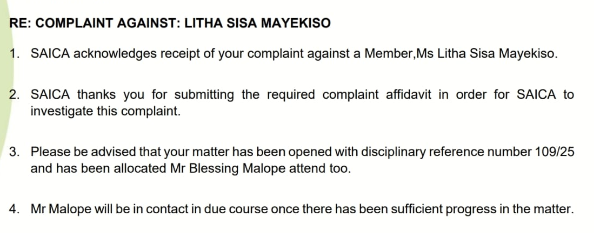
The existence of the file stands in direct contrast to a public statement issued by SAMRO in November 2025 asserting that no complaint had been lodged.
Governance allegations against a Senior Board figure
The complaint raises concerns about governance conduct linked to several decisions taken at board level within SAMRO.
Among the issues raised are allegations that governance oversight mechanisms expected from an Audit & Risk Committee chair were not adequately exercised in relation to financial controls, board conduct and key strategic decisions affecting the organisation.
Specific concerns cited in the submission include:
- The alleged failure to address an unauthorised R15,000 payment drawn from SAMRO funds for the benefit of a board member.
- Allegations that a fellow director was influenced to advance certain accusations during an Extraordinary General Meeting held on 29 August 2025.
- Concerns that a risk assessment was not properly conducted prior to the sale of a SAMRO property asset, despite the matter falling squarely within the oversight responsibilities of the Audit & Risk Committee.
- Claims that members may have been misled regarding whether consultation with the membership base was required before the sale of the building.
- Questions surrounding the process used to appoint the organisation’s Company Secretary, which complainants describe as irregular.
The allegations strike at the heart of corporate governance obligations expected of a Chartered Accountant operating in a fiduciary oversight position.
The public statement that raised questions
On 25 November 2025, the SAMRO board released a statement assuring their members and the public at large that no complaint had been filed against Mayekiso.
The board’s statement expressed full confidence in his leadership and characterised the allegations circulating in the public domain as part of an effort to damage reputations.
“The Board further affirms its full confidence in Mr. Mayekiso as the Interim Chairperson and commends his continued commitment to the organisation’s values and his professionalism and leadership. This campaign to tarnish people’s reputations is unwarranted, with far-reaching personal and professional consequences.”
However, subsequent correspondence referencing SAICA disciplinary reference 109/25 indicates that a properly formatted complaint affidavit was later submitted through the institute’s formal complaint mechanisms, triggering the establishment of an official disciplinary file.
The existence of that reference number is significant because SAICA assigns such numbers only once a complaint has passed the threshold of formal registration within its regulatory framework.
The professional duties of a Chartered Accountant
Chartered Accountants registered with SAICA operate under one of the most rigorous ethical regulatory systems in the South African professional landscape.
The SAICA Code of Professional Conduct, aligned with the international ethical standards governing the accounting profession places chartered accountants under strict obligations designed to safeguard public trust.
These obligations are anchored in five fundamental principles:
- Integrity
A chartered accountant must be honest, transparent and truthful in all professional dealings. Integrity requires the professional courage to act ethically even when doing so may be personally inconvenient or politically difficult.
- Objectivity
Accountants must avoid bias, conflicts of interest or undue influence when making professional judgments. In governance roles, this principle ensures that board decisions are taken independently and in the best interests of the organisation and its stakeholders.
- Professional competence and due care
Members must maintain the knowledge, diligence and analytical discipline required to perform their responsibilities properly. In governance structures such as audit and risk committees, this includes ensuring appropriate risk assessments, financial oversight and regulatory compliance.
- Confidentiality
Information obtained through professional roles must be safeguarded and used responsibly, preventing improper disclosure or misuse.
- Professional Behaviour
Chartered accountants must comply with laws and regulations and avoid any conduct that could bring the profession into disrepute.
The Code also requires members to apply a conceptual framework of ethical threat analysis, meaning they must actively identify and mitigate risks such as conflicts of interest, intimidation or advocacy pressures that could compromise professional judgment.
Failure to uphold these principles can trigger disciplinary proceedings by SAICA, which may include sanctions ranging from reprimands to suspension or removal from the professional register.
Fiduciary oversight in Board and Audit roles
Where a Chartered Accountant serves as both a director and the chair of an Audit & Risk Committee, the expectations become even more exacting.
Audit committees exist to act as the organisation’s primary line of governance defence, responsible for monitoring internal controls, financial reporting integrity, risk management and compliance with laws and organisational policies.
A Chairperson of such a committee is expected to:
- Ensure robust financial controls are in place.
- Investigate or escalate any irregular payments or financial anomalies.
- Conduct or commission proper risk assessments for major strategic decisions, including asset disposals.
- Ensure the board receives accurate and complete information before approving major transactions.
- Safeguard transparency and accountability in governance processes.
Because SAMRO administers royalty flows for thousands of composers, authors and publishers, governance decisions within the organisation carry significant financial and reputational consequences.
A wider governance crisis
The disciplinary complaint unfolds against a backdrop of broader turbulence within the Southern African Music Rights Organisation.
Recent months have seen a series of governance controversies within the organisation including internal disputes involving executive suspensions, contested forensic findings and ongoing demands from members for greater transparency.
Implications for SAMRO and the Accounting Profession
If the disciplinary process linked to reference 109/25 proceeds within SAICA, it could carry implications beyond the immediate governance dispute.
For SAMRO,confirmation that a formal complaint exists could raise questions about the accuracy of previous public statements issued by the board.
For the accounting profession, the case touches on the broader issue of how chartered accountants exercise their ethical obligations when occupying positions of corporate governance authority.
Chartered Accountants often serve as guardians of financial integrity in both public and private institutions. When allegations arise concerning failures of oversight or independence, they inevitably attract heightened scrutiny because the profession’s credibility rests heavily on the ethical conduct of its members.
What happens next
Disciplinary proceedings at SAICA typically begin with a preliminary investigation to determine whether sufficient grounds exist for referral to a formal disciplinary committee.
Because the process is governed by strict confidentiality rules including compliance with South Africa’s Protection of Personal Information Act (POPIA) details of ongoing cases are rarely made public until the investigation reaches a formal adjudication stage.
As of 12 March 2026, neither SAICA nor SAMRO has publicly clarified the status of disciplinary file 109/25.
The emergence of the reference number, however, places the matter squarely within the regulatory oversight framework governing one of South Africa’s most tightly regulated professions, raising significant questions about governance accountability within the country’s music rights sector.
Responding on behalf of SAMRO,Tandisizwe Mahlutshana said:
"Please note that SAMRO has received your questions and is currently attending to them. However, we regret that we will not be able to respond by your stated deadline today. We will provide a response in due course".
At the time of publication, SAICA had not responded to either the initial inquiry or the follow-up request for comment.