“Your silence is unacceptable!” McGluwa hammers DSAC into action on explosive NAC strike
The National Arts Council (NAC) strike has reached a critical boiling point on its seventh day, moving from the picket lines of Newtown to the corridors of Parliament.
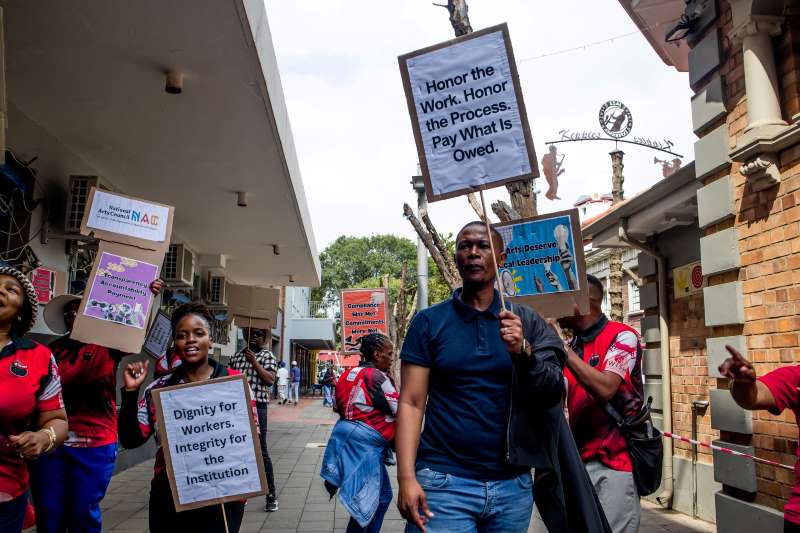
STILL STANDING: NAC employees on Day 8 of their protected industrial action in Newtown. The Department of Sport, Arts and Culture has maintained a "hands-off" approach. (Image:Facebook)
McGluwa delivers strong tongue-lashing to DSAC
On Tuesday 24 March 2026, Portfolio Committee Chairperson Joe McGluwa did not hold back when addressing the Department during a committee meeting. He directly criticised the silence from senior officials, particularly Director-General Dr Cynthia Khumalo.
McGluwa stated that the Department’s lack of response was unacceptable and could no longer be tolerated, noting that the strike had already reached day 7. He demanded that DSAC immediately provide a detailed report on developments at the NAC.
Parliament also requested full disclosure of the NAC’s legal fees as well as fees paid to council members. McGluwa emphasised the urgency, warning that prolonged disruption at the NAC, the entity responsible for supporting poor artists with few alternative sources of income could not be allowed to continue.
DSAC finally responds.
By Wednesday, DSAC issued a formal response to The Public Dispatch. In their statement, the Department acknowledged the roots of the crisis but maintained that the matter remains an operational issue for the NAC leadership.
“The Department of Sport, Arts and Culture (DSAC) is aware of the ongoing labour dispute at the National Arts Council of South Africa (NAC) relating to the non-payment of performance bonuses for the 2019-2021 financial years.”
The department emphasised that the dispute has followed due process.
“The matter has followed established labour processes. It was referred to the CCMA, where conciliation did not result in resolution. The CCMA has since issued picketing rules and confirmed that the dispute remains unresolved, which enables employees to proceed with protected industrial action, subject to those rules.”
DSAC further stressed that the situation must be understood within the legal framework governing labour disputes.
“In this context, any characterisation of the matter must be understood within the framework of the Labour Relations Act and the CCMA processes currently underway.”
Department defends non-intervention
Despite the growing crisis, DSAC made it clear that it will not directly intervene in the dispute at this stage.
“At this stage, the Department is satisfied that the matter is being managed within the appropriate governance and labour relations frameworks. Accordingly, DSAC is not intervening directly in the operational handling of the dispute, which remains the responsibility of the NAC Council and management.”
This position is likely to fuel further debate, as stakeholders including Parliament have increasingly called for more decisive action.
Monitoring measures and funding concerns
The department, however, insisted that it is actively monitoring the situation and engaging with NAC leadership.
“Senior management of the Department has met with NAC management in recent days, and the Department is receiving regular update reports, including on mitigation measures that have been put in place.”
These measures, according to DSAC, are aimed at protecting the arts sector from the fallout of the strike.
“These measures are aimed at ensuring continuity of essential operations at the NAC; and that artists and cultural organisations are not unfairly prejudiced, particularly in relation to the processing, adjudication, and disbursement of funding.”
The assurance comes amid ongoing concerns that funding streams including programmes such as the Presidential Employment Stimulus Programme (PESP) could be disrupted.
Years of tension culminate in historic strike
The strike at the NAC began on 18 March 2026 when NEHAWU members walked out over more than R1 million in unpaid performance bonuses for the 2019–2021 financial years. Staff claim the bonuses were approved but never paid, with no valid explanation given.
Workers describe years of alleged mismanagement, rapid CEO turnover (three in one year), and a toxic culture where the Council interferes in daily operations. The dispute went through the Commission for Conciliation, Mediation and Arbitration (CCMA), but conciliation failed, leading to picketing rules and protected strike action.
By day 7, frustration had spilled over: staff reported being locked out of the building, artists joined picket lines in solidarity, and calls grew for the entity to be placed under administration.
A sector watching closely
The NAC plays a critical role in supporting artists and cultural organisations across South Africa, making the ongoing strike a matter of national importance. With the financial year-end approaching, delays in funding processes could have serious consequences for the creative sector.
While DSAC has sought to reassure stakeholders that systems remain in place, uncertainty persists particularly among artists who rely on timely funding to sustain their work.